astro.wikisort.org - Asteroid
Dejopeja (minor planet designation: 184 Dejopeja) is a large M-type Main belt asteroid. It was discovered by Johann Palisa on February 28, 1878, and was named after Deiopea, a Roman nymph.
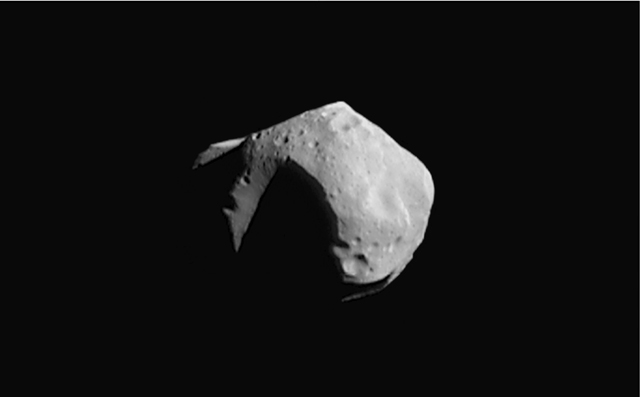
 A three-dimensional model of 184 Dejopeja based on its light curve. | |
| Discovery | |
|---|---|
| Discovered by | J. Palisa, 1878 |
| Discovery date | 28 February 1878 |
| Designations | |
MPC designation | (184) Dejopeja |
| Pronunciation | /diːoʊˈpiːə/ |
Minor planet category | Main belt |
| Orbital characteristics[1] | |
| Epoch 31 July 2016 (JD 2457600.5) | |
| Uncertainty parameter 0 | |
| Observation arc | 123.52 yr (45117 d) |
| Aphelion | 3.4005 AU (508.71 Gm) |
| Perihelion | 2.9741 AU (444.92 Gm) |
Semi-major axis | 3.1873 AU (476.81 Gm) |
| Eccentricity | 0.066883 |
Orbital period (sidereal) | 5.69 yr (2078.4 d) |
Mean anomaly | 119.18° |
Mean motion | 0° 10m 23.556s / day |
| Inclination | 1.1437° |
Longitude of ascending node | 331.61° |
Argument of perihelion | 209.72° |
| Earth MOID | 1.97613 AU (295.625 Gm) |
| Jupiter MOID | 1.56558 AU (234.207 Gm) |
| TJupiter | 3.194 |
| Physical characteristics | |
Mean radius | 33.235±1 km |
Synodic rotation period | 6.455 h (0.2690 d) |
Geometric albedo | 0.1897±0.012 |
Spectral type | M |
Absolute magnitude (H) | 8.31 |
This is an X-type asteroid with a diameter of 66 km and a geometric albedo of 0.190. Based upon Photometric observations taken during 2000, it has a synodic rotation period of 6.441 ± 0.001 h. The light curve is tri-modal, most likely due to an angular shape, with a peak-to-peak amplitude of 0.19 ± 0.01 in magnitude.[2]
References
- "184 Dejopeja". JPL Small-Body Database. NASA/Jet Propulsion Laboratory. Retrieved 6 May 2016.
- Marciniak, A.; et al. (October 2007), "Photometry and models of selected main belt asteroids. IV. 184 Dejopeja, 276 Adelheid, 556 Phyllis", Astronomy and Astrophysics, 473 (2): 633–639, Bibcode:2007A&A...473..633M, doi:10.1051/0004-6361:20077694.
External links
- 184 Dejopeja at AstDyS-2, Asteroids—Dynamic Site
- 184 Dejopeja at the JPL Small-Body Database

 | This article about an asteroid native to the asteroid belt is a stub. You can help Wikipedia by expanding it. |
На других языках
[de] (184) Dejopeja
(184) Dejopeja ist ein Asteroid des äußeren Asteroiden-Hauptgürtels, der am 28. Februar 1878 von Johann Palisa am Observatorium von Pola (heute Pula) entdeckt wurde.- [en] 184 Dejopeja
[es] (184) Dejopeja
(184) Dejopeja es un asteroide perteneciente al cinturón de asteroides descubierto el 28 de febrero de 1878 por Johann Palisa desde el observatorio de Pula, Croacia.[2] Está nombrado por Déyope,[3] un personaje de la mitología griega.[4][ru] (184) Дейопея
(184) Дейопея (лат. Dejopeja) — это довольно светлый астероид главного пояса, принадлежащий к спектральному классу M. Он был открыт 28 февраля 1878 года австрийским астрономом Иоганном Пализой в обсерватории Пула и назван в честь нимфы Дейопеи в римской мифологии[1].Текст в блоке "Читать" взят с сайта "Википедия" и доступен по лицензии Creative Commons Attribution-ShareAlike; в отдельных случаях могут действовать дополнительные условия.
Другой контент может иметь иную лицензию. Перед использованием материалов сайта WikiSort.org внимательно изучите правила лицензирования конкретных элементов наполнения сайта.
Другой контент может иметь иную лицензию. Перед использованием материалов сайта WikiSort.org внимательно изучите правила лицензирования конкретных элементов наполнения сайта.
2019-2026
WikiSort.org - проект по пересортировке и дополнению контента Википедии
WikiSort.org - проект по пересортировке и дополнению контента Википедии