astro.wikisort.org - Asteroid
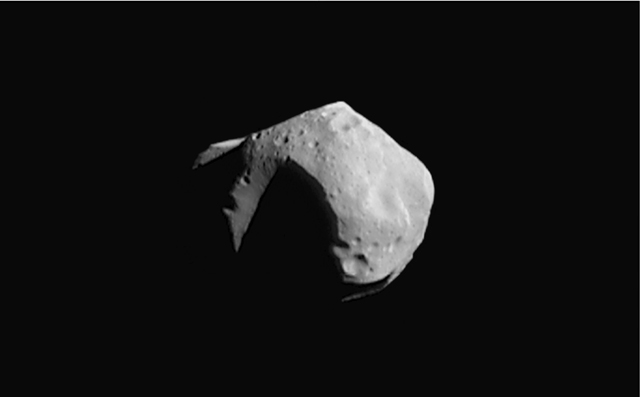
Ampella (minor planet designation: 198 Ampella) is a Main belt asteroid that was discovered by Alphonse Borrelly on June 13, 1879. The name seems to be the feminine form of Ampelos, a satyr and good friend of Dionysus in Greek mythology. It could also derive from the Ampelose (plural of Ampelos), a variety of hamadryad. It is an S-type asteroid.
| Discovery | |
|---|---|
| Discovered by | A. Borrelly, 1879 |
| Discovery date | 13 June 1879 |
| Designations | |
MPC designation | (198) Ampella |
| Pronunciation | /æmˈpɛlə/ |
Minor planet category | Main belt |
| Orbital characteristics[1] | |
| Epoch 31 July 2016 (JD 2457600.5) | |
| Uncertainty parameter 0 | |
| Observation arc | 131.26 yr (47944 d) |
| Aphelion | 3.0193 AU (451.68 Gm) |
| Perihelion | 1.8986 AU (284.03 Gm) |
Semi-major axis | 2.4589 AU (367.85 Gm) |
| Eccentricity | 0.22788 |
Orbital period (sidereal) | 3.86 yr (1408.4 d) |
Mean anomaly | 131.10° |
Mean motion | 0° 15m 20.196s / day |
| Inclination | 9.3113° |
Longitude of ascending node | 268.45° |
Argument of perihelion | 88.586° |
| Earth MOID | 0.921007 AU (137.7807 Gm) |
| Jupiter MOID | 2.52287 AU (377.416 Gm) |
| TJupiter | 3.437 |
| Physical characteristics | |
Mean radius | 28.58±1.4 km |
Synodic rotation period | 10.379 h (0.4325 d) |
Geometric albedo | 0.2517±0.027 |
Spectral type | S |
Absolute magnitude (H) | 8.33 |
So far Ampella has been observed occulting a star once, on November 8, 1991, from New South Wales, Australia.
This asteroid has been resolved by the W. M. Keck Observatory, resulting in a size estimate of 53 km. It is oblate in shape, with a size ratio of 1.22 between the major and minor axes. Measurements from the IRAS observatory gave a similar size estimate of 57 km. Photometric measurements made in 1993 give a rotation period of 10.38 hours.[2]
References
- "198 Ampella". JPL Small-Body Database. NASA/Jet Propulsion Laboratory. Archived from the original on 30 August 2020. Retrieved 6 May 2016.
- Marchis, F.; et al. (November 2006), "Shape, size and multiplicity of main-belt asteroids. I. Keck Adaptive Optics survey", Icarus, vol. 185, no. 1, pp. 39–63, Bibcode:2006Icar..185...39M, doi:10.1016/j.icarus.2006.06.001, PMC 2600456, PMID 19081813.
External links
- Lightcurve plot of 198 Ampella, Palmer Divide Observatory, B. D. Warner (2009)
- Asteroid Lightcurve Database (LCDB), query form (info Archived 16 December 2017 at the Wayback Machine)
- Dictionary of Minor Planet Names, Google books
- Asteroids and comets rotation curves, CdR – Observatoire de Genève, Raoul Behrend
- Discovery Circumstances: Numbered Minor Planets (1)-(5000) – Minor Planet Center
- 198 Ampella at AstDyS-2, Asteroids—Dynamic Site
- 198 Ampella at the JPL Small-Body Database

 | This article about an S-type asteroid native to the asteroid belt is a stub. You can help Wikipedia by expanding it. |
На других языках
[de] (198) Ampella
(198) Ampella ist ein Asteroid des Hauptgürtels, der am 13. Juni 1879 vom französischen Astronomen Alphonse Louis Nicolas Borrelly entdeckt wurde.- [en] 198 Ampella
[es] (198) Ampella
(198) Ampella es un asteroide que forma parte del cinturón de asteroides y fue descubierto por Alphonse Louis Nicolas Borrelly el 13 de junio de 1879 desde el observatorio de Marsella, Francia. Está nombrado por Ampelos, un dios de la mitología griega.[2][ru] (198) Ампелия
(198) Ампелия (др.-греч. ἄμπελος) — это астероид главного пояса, принадлежащий к спектральному классу S. Астероид был открыт 13 июня 1879 года Альфонсом Борелли и назван в честь Ампела, в древнегреческой мифологии сын сатира и нимфы, спутник и возлюбленный Диониса[1].Другой контент может иметь иную лицензию. Перед использованием материалов сайта WikiSort.org внимательно изучите правила лицензирования конкретных элементов наполнения сайта.
WikiSort.org - проект по пересортировке и дополнению контента Википедии