astro.wikisort.org - Asteroid
Constantia (minor planet designation: 315 Constantia) is a stony background asteroid from the inner region of the asteroid belt,[3] approximately 6.5 kilometers (4 miles) in diameter.[2] It was discovered by Austrian astronomer Johann Palisa at the Vienna Observatory on 4 September 1891. The asteroid is a member of the Flora family. It is spinning with a rotation period of 5.345±0.003 h and shows a brightness variation of 0.57±0.2 in magnitude.[3]
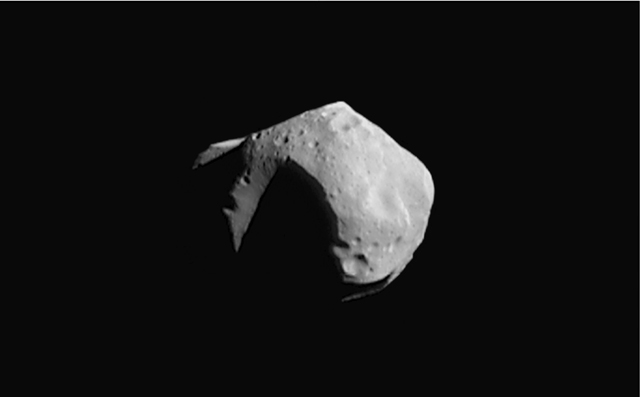
 Shape model of Constantia from its lightcurve | |
| Discovery | |
|---|---|
| Discovered by | Johann Palisa |
| Discovery date | 4 September 1891 |
| Designations | |
MPC designation | (315) Constantia |
| Pronunciation | /kənˈstænʃ(i)ə/[1] |
Minor planet category | main-belt |
| Orbital characteristics[2] | |
| Epoch 31 July 2016 (JD 2457600.5) | |
| Uncertainty parameter 0 | |
| Observation arc | 87.27 yr (31874 d) |
| Aphelion | 2.61963 AU (391.891 Gm) |
| Perihelion | 1.86231 AU (278.598 Gm) |
Semi-major axis | 2.24097 AU (335.244 Gm) |
| Eccentricity | 0.16897 |
Orbital period (sidereal) | 3.35 yr (1225.3 d) |
Average orbital speed | 19.9 km/s |
Mean anomaly | 86.6748° |
Mean motion | 0° 17m 37.673s / day |
| Inclination | 2.42916° |
Longitude of ascending node | 161.661° |
Argument of perihelion | 172.807° |
| Physical characteristics | |
| Dimensions | 5 - 12 km |
Synodic rotation period | 5.345 h (0.2227 d) |
Absolute magnitude (H) | 12.5 |
References
- "Constantia". Oxford English Dictionary (Online ed.). Oxford University Press. (Subscription or participating institution membership required.)
- "315 Constantia". JPL Small-Body Database. NASA/Jet Propulsion Laboratory. Retrieved 11 May 2016.
- Cikota, S.; et al. (February 2014), "A photometric search for active Main Belt asteroids", Astronomy & Astrophysics, 562: 8, arXiv:1401.5527, Bibcode:2014A&A...562A..94C, doi:10.1051/0004-6361/201321679, A94.
External links
- 315 Constantia at AstDyS-2, Asteroids—Dynamic Site
- 315 Constantia at the JPL Small-Body Database

 | This article about an S-type asteroid native to the asteroid belt is a stub. You can help Wikipedia by expanding it. |
На других языках
[de] (315) Constantia
(315) Constantia ist ein Asteroid des inneren Asteroiden-Hauptgürtels, der am 4. September 1891 von Johann Palisa am Observatorium von Wien entdeckt wurde.- [en] 315 Constantia
[es] (315) Constantia
(315) Constantia es un asteroide perteneciente al cinturón de asteroides descubierto el 4 de septiembre de 1891 por Johann Palisa desde el observatorio de Viena, Austria. Está nombrado por la palabra latina para constancia.[2][ru] (315) Констанция
(315) Констанция (лат. Constancy) — небольшой астероид главного пояса, который входит в состав семейство Флоры. Астероид был открыт 4 сентября 1891 года австрийским астрономом Иоганном Пализой в Венской обсерватории и назван в честь латинского термина constancy, означавшего постоянство, устойчивость[1].Текст в блоке "Читать" взят с сайта "Википедия" и доступен по лицензии Creative Commons Attribution-ShareAlike; в отдельных случаях могут действовать дополнительные условия.
Другой контент может иметь иную лицензию. Перед использованием материалов сайта WikiSort.org внимательно изучите правила лицензирования конкретных элементов наполнения сайта.
Другой контент может иметь иную лицензию. Перед использованием материалов сайта WikiSort.org внимательно изучите правила лицензирования конкретных элементов наполнения сайта.
2019-2026
WikiSort.org - проект по пересортировке и дополнению контента Википедии
WikiSort.org - проект по пересортировке и дополнению контента Википедии