astro.wikisort.org - Asteroid
Brigitta (minor planet designation: 450 Brigitta) is a typical Main belt asteroid. It is a member of the Eos family.[3]
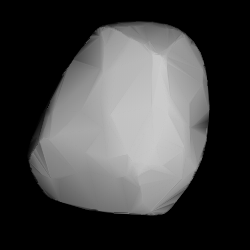 Modelled shape of Brigitta from its lightcurve | |
| Discovery | |
|---|---|
| Discovered by | M. F. Wolf A. Schwassmann |
| Discovery date | 10 October 1899 |
| Designations | |
MPC designation | (450) Brigitta |
| Pronunciation | German: [brɪˈɡɪtaː][1] |
Alternative designations | 1899 EV |
Minor planet category | Main belt (Eos) |
| Orbital characteristics[2] | |
| Epoch 31 July 2016 (JD 2457600.5) | |
| Uncertainty parameter 0 | |
| Observation arc | 116.51 yr (42557 d) |
| Aphelion | 3.31399 AU (495.766 Gm) |
| Perihelion | 2.72067 AU (407.006 Gm) |
Semi-major axis | 3.01733 AU (451.386 Gm) |
| Eccentricity | 0.098320 |
Orbital period (sidereal) | 5.24 yr (1914.4 d) |
Mean anomaly | 125.651° |
Mean motion | 0° 11m 16.976s / day |
| Inclination | 10.1548° |
Longitude of ascending node | 14.4643° |
Argument of perihelion | 356.379° |
| Physical characteristics | |
| Dimensions | 33.32±1.3 km |
Synodic rotation period | 10.75 h (0.448 d) |
Geometric albedo | 0.1229±0.010 |
Absolute magnitude (H) | 10.2 |
It was discovered by Max Wolf and A. Schwassmann on 10 October 1899 in Heidelberg.
References
- (German Names)
- "450 Brigitta (1899 EV)". JPL Small-Body Database. NASA/Jet Propulsion Laboratory. Retrieved 10 May 2016.
- Alvarez-Candal, Alvaro; et al. (December 2004), "Rotational lightcurves of asteroids belonging to families", Icarus, 172 (2): 388–401, Bibcode:2004Icar..172..388A, doi:10.1016/j.icarus.2004.06.008.
External links
- 450 Brigitta at AstDyS-2, Asteroids—Dynamic Site
- 450 Brigitta at the JPL Small-Body Database

 | This article about an asteroid native to the asteroid belt is a stub. You can help Wikipedia by expanding it. |
На других языках
[de] (450) Brigitta
(450) Brigitta ist ein Asteroid des Hauptgürtels, der am 10. Oktober 1899 von den deutschen Astronomen Max Wolf und Arnold Schwassmann in Heidelberg entdeckt wurde.- [en] 450 Brigitta
[es] (450) Brigitta
(450) Brigitta es un asteroide perteneciente al cinturón de asteroides descubierto el 10 de octubre de 1899 por Friedrich Karl Arnold Schwassmann y Maximilian Franz Wolf desde el observatorio de Heidelberg-Königstuhl, Alemania. Se desconoce la razón del nombre.[2] Forma parte de la familia asteroidal de Eos.[3][ru] (450) Бригитта
(450) Бригитта (лат. Brigitta) — астероид из группы главного пояса, который входит в состав семейства Эос[1]. Был открыт 10 октября 1899 года немецкими астрономами Максом Вольфом и Фридрихом Швассманом в обсерватории Хайдельберг. Астероид назван в честь католической святой Бригитты ШведскойТекст в блоке "Читать" взят с сайта "Википедия" и доступен по лицензии Creative Commons Attribution-ShareAlike; в отдельных случаях могут действовать дополнительные условия.
Другой контент может иметь иную лицензию. Перед использованием материалов сайта WikiSort.org внимательно изучите правила лицензирования конкретных элементов наполнения сайта.
Другой контент может иметь иную лицензию. Перед использованием материалов сайта WikiSort.org внимательно изучите правила лицензирования конкретных элементов наполнения сайта.
2019-2026
WikiSort.org - проект по пересортировке и дополнению контента Википедии
WikiSort.org - проект по пересортировке и дополнению контента Википедии