astro.wikisort.org - Asteroid
Venusia (minor planet designation: 499 Venusia) is an asteroid in the outer asteroid belt, discovered by Max Wolf in 1902.[3] Its diameter is 81 km (50.6 miles).[4] It is a dark P-type asteroid. It has an average distance from the Sun of 4 AU (600 million km).[2]
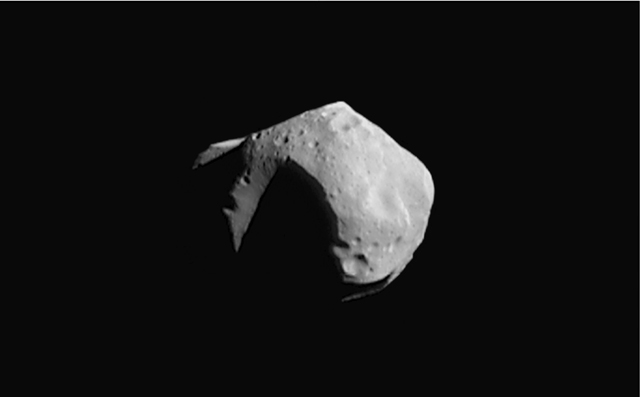
 A three-dimensional model of 499 Venusia based on its light curve | |
| Discovery | |
|---|---|
| Discovered by | Max Wolf |
| Discovery site | Heidelberg |
| Discovery date | 24 December 1902 |
| Designations | |
MPC designation | (499) Venusia |
| Pronunciation | /vɪˈnjuːʃiə/[1] |
Alternative designations | 1902 KX |
| Orbital characteristics[2] | |
| Epoch 31 July 2016 (JD 2457600.5) | |
| Uncertainty parameter 0 | |
| Observation arc | 113.31 yr (41388 d) |
| Aphelion | 4.8693 AU (728.44 Gm) |
| Perihelion | 3.1479 AU (470.92 Gm) |
Semi-major axis | 4.0086 AU (599.68 Gm) |
| Eccentricity | 0.21471 |
Orbital period (sidereal) | 8.03 yr (2931.4 d) |
Mean anomaly | 149.18° |
Mean motion | 0° 7m 22.116s / day |
| Inclination | 2.0907° |
Longitude of ascending node | 256.245° |
Argument of perihelion | 174.952° |
| Physical characteristics | |
Mean radius | 40.69±1.65 km |
Synodic rotation period | 13.48 h (0.562 d) |
Geometric albedo | 0.0468±0.004 |
Absolute magnitude (H) | 9.39 |
References
- Noah Webster (1884) A Practical Dictionary of the English Language
- "499 Venusia (1902 KX)". JPL Small-Body Database. NASA/Jet Propulsion Laboratory. Retrieved 6 May 2016.
- Lutz D. Schmadel (9 March 2013). Dictionary of Minor Planet Names. Springer Science & Business Media. pp. 84–. ISBN 978-3-662-02804-9.
- Thomas Wm Hamilton (15 April 2014). Dwarf Planets and Asteroids: Minor Bodies of the Solar System. Strategic Book Publishing Rights Agency. pp. 27–. ISBN 978-1-62857-728-0.
External links
- 499 Venusia at AstDyS-2, Asteroids—Dynamic Site
- 499 Venusia at the JPL Small-Body Database

 | This article about an asteroid native to the asteroid belt is a stub. You can help Wikipedia by expanding it. |
На других языках
[de] (499) Venusia
(499) Venusia ist ein Asteroid des Hauptgürtels, der am 24. Dezember 1902 vom deutschen Astronomen Max Wolf in Heidelberg entdeckt wurde.- [en] 499 Venusia
[es] (499) Venusia
(499) Venusia es un asteroide perteneciente al cinturón exterior de asteroides descubierto el 24 de diciembre de 1902 por Maximilian Franz Wolf desde el observatorio de Heidelberg-Königstuhl, Alemania. Está nombrado por la isla de Ven.[2][ru] (499) Венузия
(499) Венузия (швед. Venusia) — крупный астероид внешней части главного пояса, который принадлежит к тёмному спектральному классу P. Он был открыт 24 декабря 1902 года немецким астрономом Максом Вольфом в обсерватории Хайдельберга и назван в честь шведского острова Вен[1].Текст в блоке "Читать" взят с сайта "Википедия" и доступен по лицензии Creative Commons Attribution-ShareAlike; в отдельных случаях могут действовать дополнительные условия.
Другой контент может иметь иную лицензию. Перед использованием материалов сайта WikiSort.org внимательно изучите правила лицензирования конкретных элементов наполнения сайта.
Другой контент может иметь иную лицензию. Перед использованием материалов сайта WikiSort.org внимательно изучите правила лицензирования конкретных элементов наполнения сайта.
2019-2026
WikiSort.org - проект по пересортировке и дополнению контента Википедии
WikiSort.org - проект по пересортировке и дополнению контента Википедии