astro.wikisort.org - Asteroid
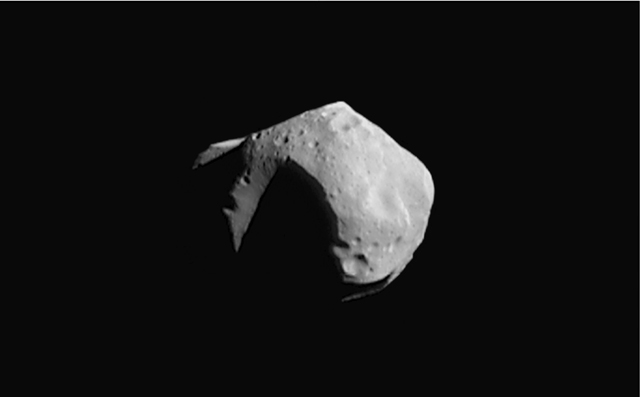
622 Esther is a minor planet orbiting the Sun.
| Discovery | |
|---|---|
| Discovered by | Joel Hastings Metcalf |
| Discovery site | Taunton, Massachusetts |
| Discovery date | 13 November 1906 |
| Designations | |
MPC designation | (622) Esther |
Named after | Esther (biblical figure)[1] |
Alternative designations | 1906 WP |
Minor planet category | main-belt · (inner) |
| Orbital characteristics[2] | |
| Epoch 31 July 2016 (JD 2457600.5) | |
| Uncertainty parameter 0 | |
| Observation arc | 109.40 yr (39959 d) |
| Aphelion | 2.9999 AU (448.78 Gm) |
| Perihelion | 1.8313 AU (273.96 Gm) |
Semi-major axis | 2.4156 AU (361.37 Gm) |
| Eccentricity | 0.24189 |
Orbital period (sidereal) | 3.75 yr (1371.3 d) |
Mean anomaly | 93.681° |
Mean motion | 0° 15m 45.072s / day |
| Inclination | 8.6435° |
Longitude of ascending node | 142.046° |
Argument of perihelion | 256.687° |
| Earth MOID | 0.859795 AU (128.6235 Gm) |
| Jupiter MOID | 2.48023 AU (371.037 Gm) |
| TJupiter | 3.461 |
| Physical characteristics[3] | |
| Dimensions | 40 × 24 × 24 km ± 26% 29±8 km |
Sidereal rotation period | 47.5 h (1.98 d) |
Spectral type | S-type asteroid |
Absolute magnitude (H) | 10.3 |
The asteroid is named after the biblical figure Esther.[1]
In 2001, the asteroid was detected by radar from the Arecibo Observatory at a distance of 1.11 AU. The resulting data yielded an effective diameter of 29 ± 8 km.[3]
References
- Lutz D. Schmadel (2003). Dictionary of Minor Planet Names (Fifth ed.). Heidelberg, N. Y: Springer Science & Business Media. p. 63. ISBN 978-3-540-00238-3.
- "622 Esther (1906 WP)". JPL Small-Body Database. NASA/Jet Propulsion Laboratory. Retrieved 5 May 2016.
- Magri, Christopher; et al. (January 2007), "A radar survey of main-belt asteroids: Arecibo observations of 55 objects during 1999 2003" (PDF), Icarus, 186 (1): 126–151, Bibcode:2007Icar..186..126M, doi:10.1016/j.icarus.2006.08.018, retrieved 14 April 2015.
External links
- 622 Esther at AstDyS-2, Asteroids—Dynamic Site
- 622 Esther at the JPL Small-Body Database

 | This article about an S-type asteroid native to the asteroid belt is a stub. You can help Wikipedia by expanding it. |
На других языках
[de] (622) Esther
(622) Esther ist ein Asteroid des Hauptgürtels, der am 13. November 1906 von Joel H. Metcalf entdeckt wurde.- [en] 622 Esther
[es] (622) Esther
(622) Esther es un asteroide perteneciente al cinturón de asteroides descubierto por Joel Hastings Metcalf desde el observatorio de Taunton, Estados Unidos, el 13 de noviembre de 1906.[ru] (622) Эсфирь
(622) Эсфирь или (622) Есфирь (нем. Esther) — астероид в поясе астероидов, который был открыт 13 ноября 1906 года американским астрономом Джоэлом Меткалфом в обсерватории города Тонтоне и назван в честь библейской фигуры Есфирь[1].Текст в блоке "Читать" взят с сайта "Википедия" и доступен по лицензии Creative Commons Attribution-ShareAlike; в отдельных случаях могут действовать дополнительные условия.
Другой контент может иметь иную лицензию. Перед использованием материалов сайта WikiSort.org внимательно изучите правила лицензирования конкретных элементов наполнения сайта.
Другой контент может иметь иную лицензию. Перед использованием материалов сайта WikiSort.org внимательно изучите правила лицензирования конкретных элементов наполнения сайта.
2019-2026
WikiSort.org - проект по пересортировке и дополнению контента Википедии
WikiSort.org - проект по пересортировке и дополнению контента Википедии