astro.wikisort.org - Asteroid
695 Bella is a minor planet orbiting the Sun.
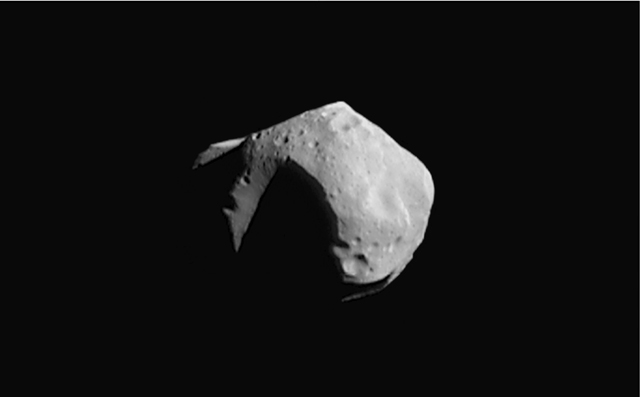
 A three-dimensional model of 695 Bella based on its light curve | |
| Discovery | |
|---|---|
| Discovered by | Joel Hastings Metcalf |
| Discovery site | Taunton, Massachusetts |
| Discovery date | 7 November 1909 |
| Designations | |
MPC designation | (695) Bella |
Alternative designations | 1909 JB |
| Orbital characteristics[1] | |
| Epoch 31 July 2016 (JD 2457600.5) | |
| Uncertainty parameter 0 | |
| Observation arc | 102.48 yr (37432 d) |
| Aphelion | 2.9457 AU (440.67 Gm) |
| Perihelion | 2.1375 AU (319.77 Gm) |
Semi-major axis | 2.5416 AU (380.22 Gm) |
| Eccentricity | 0.15900 |
Orbital period (sidereal) | 4.05 yr (1480.0 d) |
Mean anomaly | 183.825° |
Mean motion | 0° 14m 35.7s / day |
| Inclination | 13.838° |
Longitude of ascending node | 275.632° |
Argument of perihelion | 79.589° |
| Physical characteristics | |
Mean radius | 24.09±0.75 km |
Synodic rotation period | 14.222 h (0.5926 d) |
Geometric albedo | 0.1450±0.009 |
Absolute magnitude (H) | 9.30 |
Although this asteroid has dynamic properties that make it a candidate for the Maria family, the spectral properties of the object indicate it is most likely an interloper. Instead, it may have been spalled off from 6 Hebe or its parent body. 695 Bella and 6 Hebe orbit on opposite sides of the 3:1 Kirkwood gap, and the two have similar orbital elements.[2]
References
- "695 Bella (1909 JB)". JPL Small-Body Database. NASA/Jet Propulsion Laboratory. Retrieved 5 May 2016.
- Fieber-Beyer, Sherry K.; et al. (June 2011), "The Maria asteroid family: Genetic relationships and a plausible source of mesosiderites near the 3:1 Kirkwood Gap", Icarus, 213 (2): 524–537, Bibcode:2011Icar..213..524F, doi:10.1016/j.icarus.2011.03.009, retrieved 23 December 2015.
External links
- 695 Bella at AstDyS-2, Asteroids—Dynamic Site
- 695 Bella at the JPL Small-Body Database

 | This article about an asteroid native to the asteroid belt is a stub. You can help Wikipedia by expanding it. |
На других языках
[de] (695) Bella
(695) Bella ist ein Asteroid des Hauptgürtels, der am 7. November 1909 vom US-amerikanischen Astronomen Joel H. Metcalf in Taunton, Massachusetts entdeckt wurde.- [en] 695 Bella
[es] (695) Bella
(695) Bella es un asteroide perteneciente al cinturón de asteroides descubierto por Joel Hastings Metcalf el 7 de noviembre de 1909 desde el observatorio de Taunton, Estados Unidos.[ru] (695) Белла
(695) Белла (англ. Bella) — астероид главного пояса, который относится к спектральному классу S. Он был открыт 7 ноября 1909 года американским астрономом Джоэлом Меткалфом в Тонтонской обсерватории. Тиссеранов параметр относительно Юпитера — 3,388.Текст в блоке "Читать" взят с сайта "Википедия" и доступен по лицензии Creative Commons Attribution-ShareAlike; в отдельных случаях могут действовать дополнительные условия.
Другой контент может иметь иную лицензию. Перед использованием материалов сайта WikiSort.org внимательно изучите правила лицензирования конкретных элементов наполнения сайта.
Другой контент может иметь иную лицензию. Перед использованием материалов сайта WikiSort.org внимательно изучите правила лицензирования конкретных элементов наполнения сайта.
2019-2026
WikiSort.org - проект по пересортировке и дополнению контента Википедии
WikiSort.org - проект по пересортировке и дополнению контента Википедии