astro.wikisort.org - Asteroid
875 Nymphe is a minor planet orbiting the Sun. It is a member of the Maria family of asteroids.[3]
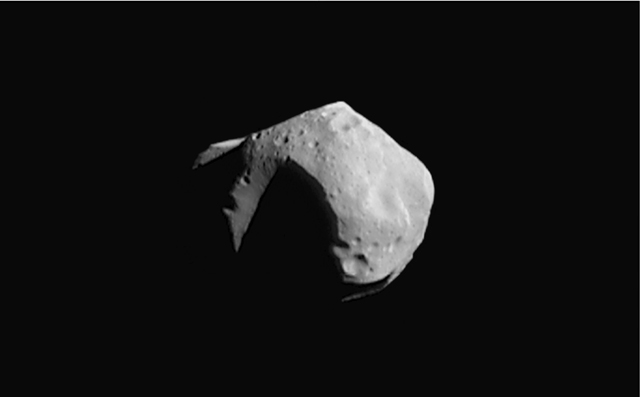
 A three-dimensional model of 875 Nymphe based on its light curve | |
| Discovery | |
|---|---|
| Discovered by | Max Wolf |
| Discovery site | Heidelberg |
| Discovery date | 19 May 1917 |
| Designations | |
MPC designation | (875) Nymphe |
| Pronunciation | /ˈnɪmfiː/ |
Alternative designations | 1917 CF |
| Adjectives | Nymphean /nɪmˈfiːən/[1] |
| Orbital characteristics[2] | |
| Epoch 31 July 2016 (JD 2457600.5) | |
| Uncertainty parameter 0 | |
| Observation arc | 98.37 yr (35928 days) |
| Aphelion | 2.9403 AU (439.86 Gm) |
| Perihelion | 2.1660 AU (324.03 Gm) |
Semi-major axis | 2.5531 AU (381.94 Gm) |
| Eccentricity | 0.15162 |
Orbital period (sidereal) | 4.08 yr (1490.1 d) |
Mean anomaly | 43.2941° |
Mean motion | 0° 14m 29.76s / day |
| Inclination | 14.575° |
Longitude of ascending node | 196.094° |
Argument of perihelion | 117.430° |
| Earth MOID | 1.19548 AU (178.841 Gm) |
| Jupiter MOID | 2.47772 AU (370.662 Gm) |
| TJupiter | 3.378 |
| Physical characteristics | |
Mean radius | 6.875±0.3 km |
Synodic rotation period | 9.57 ± 0.01 h,[3] 12.618 h (0.5258 d)[2] |
Geometric albedo | 0.2346±0.022 |
Absolute magnitude (H) | 11.2 |
References
- "nymphean". Oxford English Dictionary (Online ed.). Oxford University Press. (Subscription or participating institution membership required.)
- "875 Nymphe (1917 CF)". JPL Small-Body Database. NASA/Jet Propulsion Laboratory. Retrieved 3 May 2016.
- Alvarez-Candal, Alvaro; et al. (December 2004), "Rotational lightcurves of asteroids belonging to families", Icarus, 172 (2): 388–401, Bibcode:2004Icar..172..388A, doi:10.1016/j.icarus.2004.06.008.
External links
- Lightcurve plot of 875 Nymphe, Palmer Divide Observatory, B. D. Warner (2003)
- Asteroid Lightcurve Database (LCDB), query form (info Archived 16 December 2017 at the Wayback Machine)
- Dictionary of Minor Planet Names, Google books
- Asteroids and comets rotation curves, CdR – Observatoire de Genève, Raoul Behrend
- Discovery Circumstances: Numbered Minor Planets (1)-(5000) – Minor Planet Center
- 875 Nymphe at AstDyS-2, Asteroids—Dynamic Site
- 875 Nymphe at the JPL Small-Body Database

 | This article about an asteroid native to the asteroid belt is a stub. You can help Wikipedia by expanding it. |
На других языках
[de] (875) Nymphe
(875) Nymphe ist ein Asteroid des Hauptgürtels, der am 19. Mai 1917 vom deutschen Astronomen Max Wolf in Heidelberg entdeckt wurde.- [en] 875 Nymphe
[fr] (875) Nymphe
(875) Nymphe est un astéroïde de la ceinture principale découvert par Max Wolf le 19 mai 1917.[ru] (875) Нимфея
875 Нимфе́я (лат. Nymphe) — небольшой, но довольно яркий астероид главного пояса. Открыт 19 мая 1917 года немецким астрономом Максом Вольфом в обсерватория Гейдельберг-Кёнигштуль, Германия. Астероид назван в честь стихийных сил, которые согласно древнегреческой мифологии олицетворялись в виде девушек — нимф.Текст в блоке "Читать" взят с сайта "Википедия" и доступен по лицензии Creative Commons Attribution-ShareAlike; в отдельных случаях могут действовать дополнительные условия.
Другой контент может иметь иную лицензию. Перед использованием материалов сайта WikiSort.org внимательно изучите правила лицензирования конкретных элементов наполнения сайта.
Другой контент может иметь иную лицензию. Перед использованием материалов сайта WikiSort.org внимательно изучите правила лицензирования конкретных элементов наполнения сайта.
2019-2026
WikiSort.org - проект по пересортировке и дополнению контента Википедии
WikiSort.org - проект по пересортировке и дополнению контента Википедии