astro.wikisort.org - Galaxy
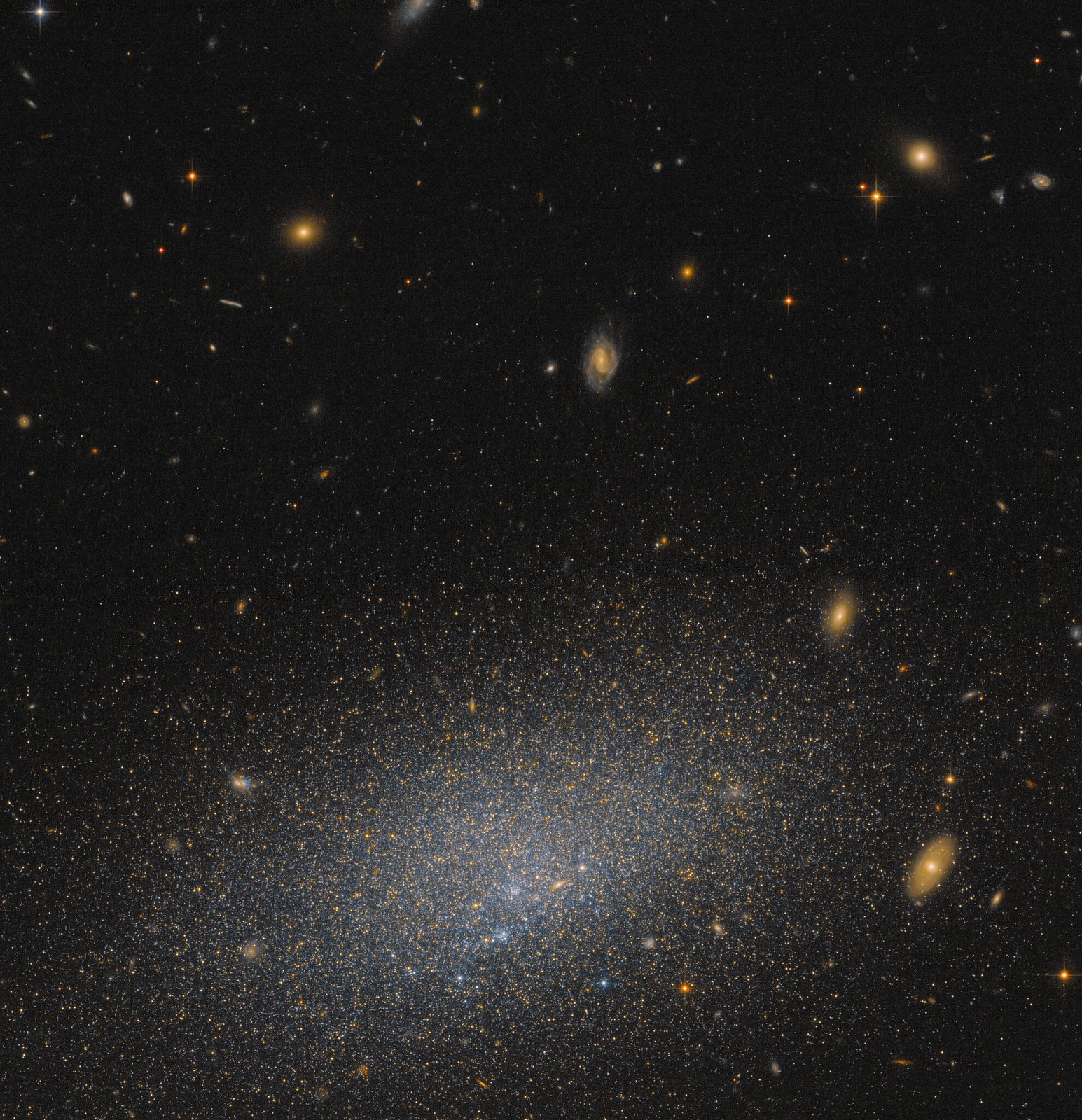
UGC 4879, which is also known as VV 124, is the most isolated dwarf galaxy in the periphery of the Local Group. It is an irregular galaxy at a distance of 1.38 Mpc. Low-resolution spectroscopy yielded inconsistent radial velocities for different components of the galaxy, hinting at the presence of a stellar disk. There is also evidence of this galaxy containing dark matter.
| UGC 4879 | |
|---|---|
 UGC 4879, taken using the Hubble Space Telescope's Advanced Camera for Surveys | |
| Observation data (J2000 epoch) | |
| Constellation | Ursa Major |
| Right ascension | 09h 16m 02.023s[1] |
| Declination | +52° 50′ 42.05″[1] |
| Redshift | -0.000233[2] |
| Helio radial velocity | -70[2] |
| Distance | 4.18 ± 0.41 Mly (1.283 ± 0.126 Mpc)[2] |
| Group or cluster | Local Group |
| Apparent magnitude (V) | 13.2[3] |
| Apparent magnitude (B) | 14.0[3] |
| Characteristics | |
| Type | IAm[2] |
| Size | 3,000 ly (930 pc)[2] |
| Apparent size (V) | 2.5′ × 1.5′[2] |
| Notable features | Isolated dwarf galaxy in the Local Group |
| Other designations | |
| VV 124, MGC+09-15-113, PGC 26142[3] | |
Appearance
UGC 4879 is a transition type galaxy, meaning it has no rings (Denoted rs). It is also a spheroidal (dSph) galaxy, meaning it has a low luminosity. It has little to no gas or dust, and little recent star formation. It is also irregular, meaning it has no specific form.[4]
Gallery
![There are about 2.3 million light years between UGC 4879 and its closest neighbour, Leo A.[5]](http://upload.wikimedia.org/wikipedia/commons/e/e0/A_mysterious_hermit.jpg)
References
- Adelman-McCarthy, J. K.; et al. (2009). "VizieR Online Data Catalog: The SDSS Photometric Catalog, Release 7". VizieR On-line Data Catalog. Bibcode:2009yCat.2294....0A.
- "NED results for object UGC 4879". National Aeronautics and Space Administration / Infrared Processing and Analysis Center. Retrieved 19 February 2017.
- "UGC 4879". SIMBAD. Centre de données astronomiques de Strasbourg. Retrieved 19 February 2017.
- Kopylov, A. I.; Tikhonov, N. A.; Fabrika, S.; Drozdovsky, I.; Valeev, A. F. (2008). "VV124 (UGC4879): A new transitional dwarf galaxy in the periphery of the Local Group". Monthly Notices of the Royal Astronomical Society: Letters. 387 (1): L45–L49. arXiv:0803.1107. Bibcode:2008MNRAS.387L..45K. doi:10.1111/j.1745-3933.2008.00482.x. S2CID 17166212.
- "A mysterious hermit". Retrieved 8 June 2016.
External links

Wikimedia Commons has media related to UGC 4879.
Текст в блоке "Читать" взят с сайта "Википедия" и доступен по лицензии Creative Commons Attribution-ShareAlike; в отдельных случаях могут действовать дополнительные условия.
Другой контент может иметь иную лицензию. Перед использованием материалов сайта WikiSort.org внимательно изучите правила лицензирования конкретных элементов наполнения сайта.
Другой контент может иметь иную лицензию. Перед использованием материалов сайта WikiSort.org внимательно изучите правила лицензирования конкретных элементов наполнения сайта.
2019-2026
WikiSort.org - проект по пересортировке и дополнению контента Википедии
WikiSort.org - проект по пересортировке и дополнению контента Википедии