astro.wikisort.org - Asteroid
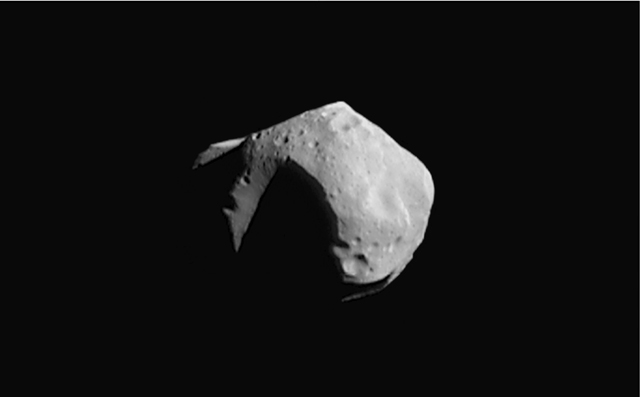
Tauntonia (minor planet designation: 581 Tauntonia) is a dark Alauda asteroid from the outer region of the asteroid belt, approximately 61 kilometers in diameter.[2]
| Discovery | |
|---|---|
| Discovered by | J. H. Metcalf |
| Discovery site | Taunton, Massachusetts |
| Discovery date | 24 December 1905 |
| Designations | |
MPC designation | (581) Tauntonia |
| Pronunciation | /tɔːnˈtoʊniə/ |
Alternative designations | 1905 SH |
Minor planet category | main-belt · (outer) Alauda [1] |
| Orbital characteristics[2] | |
| Epoch 31 July 2016 (JD 2457600.5) | |
| Uncertainty parameter 0 | |
| Observation arc | 110.15 yr (40233 d) |
| Aphelion | 3.3180 AU (496.37 Gm) |
| Perihelion | 3.1101 AU (465.26 Gm) |
Semi-major axis | 3.2140 AU (480.81 Gm) |
| Eccentricity | 0.032339 |
Orbital period (sidereal) | 5.76 yr (2104.6 d) |
Mean anomaly | 24.277° |
Mean motion | 0° 10m 15.78s / day |
| Inclination | 21.878° |
Longitude of ascending node | 102.603° |
Argument of perihelion | 28.971° |
| Physical characteristics | |
| Dimensions | 61.481±0.265 km[2] |
Synodic rotation period | 16.54 h (0.689 d)[2] |
Geometric albedo | 0.031±0.005[2] |
Spectral type | Xk (SMASSII)[2] |
Absolute magnitude (H) | 9.8[2] |
The asteroid is a member of the Alauda family (902),[1] a large family of typically bright carbonaceous asteroids and named after its parent body, 702 Alauda.[3]: 23
References
- "Asteroid 581 Tauntonia – Nesvorny HCM Asteroid Families V3.0". Small Bodies Data Ferret. Retrieved 24 October 2019.
- "581 Tauntonia (1905 SH)". JPL Small-Body Database. NASA/Jet Propulsion Laboratory. Retrieved 5 May 2016.
- Nesvorný, D.; Broz, M.; Carruba, V. (December 2014). Identification and Dynamical Properties of Asteroid Families. Asteroids IV. pp. 297–321. arXiv:1502.01628. Bibcode:2015aste.book..297N. doi:10.2458/azu_uapress_9780816532131-ch016. ISBN 9780816532131.
External links
- Lightcurve plot of 581 Tauntonia, Palmer Divide Observatory, B. D. Warner (2000)
- Asteroid Lightcurve Database (LCDB), query form (info Archived 16 December 2017 at the Wayback Machine)
- Dictionary of Minor Planet Names, Google books
- Asteroids and comets rotation curves, CdR – Observatoire de Genève, Raoul Behrend
- Discovery Circumstances: Numbered Minor Planets (1)-(5000) – Minor Planet Center
- 581 Tauntonia at AstDyS-2, Asteroids—Dynamic Site
- 581 Tauntonia at the JPL Small-Body Database

 | This article about an asteroid native to the asteroid belt is a stub. You can help Wikipedia by expanding it. |
На других языках
[de] (581) Tauntonia
(581) Tauntonia ist ein Asteroid des Hauptgürtels, der am 24. Dezember 1905 von Joel H. Metcalf entdeckt wurde.- [en] 581 Tauntonia
[es] (581) Tauntonia
(581) Tauntonia es un asteroide que forma parte del cinturón exterior de asteroides y fue descubierto el 24 de diciembre de 1905 por Joel Hastings Metcalf desde el observatorio de Taunton, Estados Unidos.[ru] (581) Таунтония
(581) Таунтония (англ. Tauntonia) — крупный астероид Главного пояса, который был открыт 24 декабря 1905 года американским астрономом Джоэлом Меткалфом и назван в честь американского города Таунтон (штат Массачусетс, США), откуда первооткрыватель вёл свои наблюдения[1].Текст в блоке "Читать" взят с сайта "Википедия" и доступен по лицензии Creative Commons Attribution-ShareAlike; в отдельных случаях могут действовать дополнительные условия.
Другой контент может иметь иную лицензию. Перед использованием материалов сайта WikiSort.org внимательно изучите правила лицензирования конкретных элементов наполнения сайта.
Другой контент может иметь иную лицензию. Перед использованием материалов сайта WikiSort.org внимательно изучите правила лицензирования конкретных элементов наполнения сайта.
2019-2026
WikiSort.org - проект по пересортировке и дополнению контента Википедии
WikiSort.org - проект по пересортировке и дополнению контента Википедии