astro.wikisort.org - Star
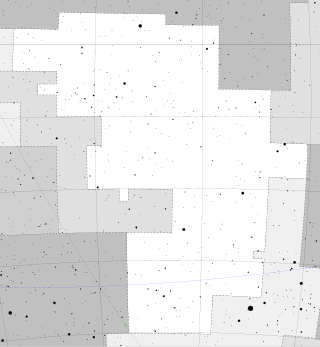
WISEP J180026.60+013453.1 (designation is abbreviated to W1800+0134[1]) is a brown dwarf of spectral class L7.5,[1] located in constellation Ophiuchus at approximately 26 light-years from Earth.[1]
| Observation data Epoch 2010.22[1] Equinox J2000[1] | |
|---|---|
| Constellation | Ophiuchus |
| Right ascension | 18h 00m 26.60s[1] |
| Declination | 01° 34′ 53.1″[1] |
| Characteristics | |
| Spectral type | L7.5[1] |
| Apparent magnitude (J (2MASS filter system)) | 14.30 ± 0.04[1] |
| Apparent magnitude (H (2MASS filter system)) | 13.12 ± 0.04[1] |
| Apparent magnitude (KS (2MASS filter system)) | 12.42 ± 0.03[1] |
| Astrometry | |
| Proper motion (μ) | RA: 183.734[2] mas/yr Dec.: -384.108[2] mas/yr |
| Parallax (π) | 128.0546 ± 0.5101 mas[2] |
| Distance | 25.5 ± 0.1 ly (7.81 ± 0.03 pc) |
| Details | |
| Mass | 0.045±0.015[3] M☉ |
| Luminosity | 10−4.53 ± 0.04[3] L☉ |
| Temperature | 1430 ± 100[1] K |
| Rotation | 9.3 hours[3] |
| Rotational velocity (v sin i) | 13.5±0.5[3] km/s |
| Age | 0.9±0.6[3] Gyr |
| Other designations | |
| Database references | |
| SIMBAD | data |
  | |
Discovery
WISEP J180026.60+013453.1 was discovered in 2011 by Gizis et al. from data, collected by Wide-field Infrared Survey Explorer (WISE) Earth-orbiting satellite — NASA infrared-wavelength 40 centimetres (16 in)) space telescope, which mission lasted from December 2009 to February 2011. There are also precovery identifications of this object in Two Micron All-Sky Survey (2MASS) data (observed on 2000 September 23) and in the 3rd release of the DENIS database (close in time to the 2MASS observation).[1] On 2011 June 22 Gizis et al. had conducted near-infrared spectroscopy with SpeX spectrograph, mounted on the 3 m Infrared Telescope Facility (IRTF), located at the Mauna Kea Observatory in Hawaii.[1] In 2011 Gizis et al. published a paper in The Astronomical Journal, where they presented discovery of a newfound by WISE L-type brown dwarf WISEP J180026.60+013453.1 (a single discovery, presented in the article).[1]
Physical properties
WISEP J180026.60+013453.1 has temperature 1430 ± 100 K and luminosity 10−4.5 ± 0.3 Solar luminosities (the estimates are based on the object's spectral class (L7.5)).[1] Mass estimates, determined from this temperature, are 0.04,[note 1] 0.05,[note 2] and 0.074[note 3] Solar masses, anyway below the hydrogen-burning limit, which implies that WISEP J180026.60+013453.1 is not a true star, but only a substellar object, that is a brown dwarf.[1]
Failed test for binarity
WISEP J180026.60+013453.1 was tested spectroscopically for L + T binarity, and the binarity was not revealed.[1] Common proper motion companions also were not found.[1]
See also
- List of star systems within 25–30 light-years
- WISE 0031-3840 (L2 pec (blue))
- WISE 0049+0441 (L9)
- WISE 0206+2640 (L9 pec (red))
- WISE 1311+3629 (L5 pec (blue))
- WISE 1348+6603 (L9)
- WISE 1647+5632 (L9 pec (red))
- WISE 1830+4542 (L9)
- WISE 2327-2730 (L9)
- WISE 0607+2429 (L8)
- WISE 0106+1518 (M8 pec)
Notes
- For an assumed age 0.5 Gyr.
- For an assumed age 1 Gyr.
- For an assumed age 5 Gyr.
References
- Gizis, John E.; Burgasser, Adam J.; Faherty, Jacqueline K.; Castro, Philip J.; Shara, Michael M. (2011). "WISEP J180026.60+013453.1: A nearby late-L Dwarf near the Galactic Plane". The Astronomical Journal. 142 (5): 171. arXiv:1109.0054. Bibcode:2011AJ....142..171G. doi:10.1088/0004-6256/142/5/171. S2CID 118596629.
- Brown, A. G. A.; et al. (Gaia collaboration) (2021). "Gaia Early Data Release 3: Summary of the contents and survey properties". Astronomy & Astrophysics. 649: A1. arXiv:2012.01533. Bibcode:2021A&A...649A...1G. doi:10.1051/0004-6361/202039657. S2CID 227254300. Gaia EDR3 record for this source at VizieR.
- Gizis, John E.; et al. (2015). "Properties of the Nearby Brown Dwarf WISEP J180026.60+013453.1". The Astronomical Journal. 150 (6). 179. arXiv:1509.04690. Bibcode:2015AJ....150..179G. doi:10.1088/0004-6256/150/6/179. S2CID 118641133.
- "WISEP J180026.60+013453.1 -- Brown Dwarf (M<0.08solMass)". SIMBAD. Centre de données astronomiques de Strasbourg. Retrieved 2012-12-24.
Другой контент может иметь иную лицензию. Перед использованием материалов сайта WikiSort.org внимательно изучите правила лицензирования конкретных элементов наполнения сайта.
WikiSort.org - проект по пересортировке и дополнению контента Википедии