astro.wikisort.org - Asteroid
2011 MD is a bright micro-asteroid, classified as near-Earth object of the Apollo and Amor group, respectively.[1][3] On 27 June 2011, at around 17:00 UTC (13:00 EDT), the object passed exceptionally close to Earth's surface at a distance of approximately 12,000 kilometers (7,500 mi), roughly the diameter of the Earth.[6][7][8]
 2011 MD imaged by Spitzer in February 2014 | |
| Discovery[1][2] | |
|---|---|
| Discovered by | LINEAR |
| Discovery site | Lincoln Lab's ETS |
| Discovery date | 2011 June 22 (first observed only) |
| Designations | |
MPC designation | 2011 MD |
Minor planet category | NEO · Apollo[1] · Amor[3] |
| Orbital characteristics[1] | |
| Epoch 13 July 2011 (JD 2455755.5) | |
| Uncertainty parameter 2[1] · 0[3] | |
| Observation arc | 2.65 yr (967 days) |
| Aphelion | 1.1031 AU |
| Perihelion | 1.0161 AU |
Semi-major axis | 1.0596 AU |
| Eccentricity | 0.0411 |
Orbital period (sidereal) | 1.09 yr (398 days) |
Mean anomaly | 11.051° |
Mean motion | 0° 54m 13.32s / day |
| Inclination | 2.5624° |
Longitude of ascending node | 273.96° |
Argument of perihelion | 4.6748° |
| Earth MOID | 0.0003 AU (0.1 LD) |
| Physical characteristics | |
Mean diameter | 6 m (estimate)[4][5] |
Mean density | 1 g/cm3 (est. rubble pile)[4] |
Synodic rotation period | 0.1937 h[1] |
Geometric albedo | 0.3[5] |
Absolute magnitude (H) | 28.0[1] |
Description
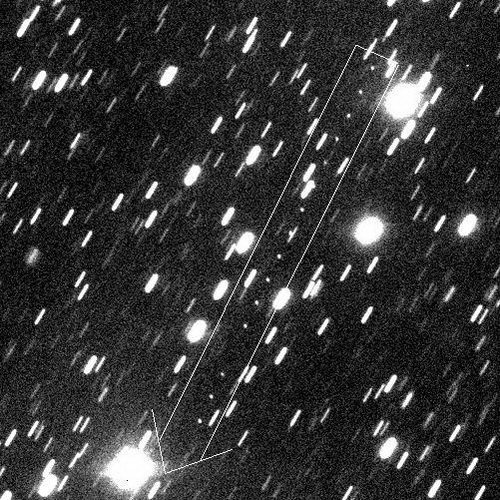
Although 2011 MD was initially believed to be space junk, subsequent observations confirmed that it is an asteroid. A few hours before the asteroid's nearest approach in 2011, it appeared close to the Sun, so observations were possible for only a brief period. Backyard astronomers were able to observe it with telescopes from Australia, southern Africa, and the Americas.[7]
2011 MD was discovered on 22 June 2011, by astronomers of the Lincoln Near-Earth Asteroid Research (LINEAR) at the U.S. Lincoln Laboratory Experimental Test Site in Socorro, New Mexico, by a pair of robotic telescopes. According to original rough estimates, the asteroid's length was between 10 and 45 meters (30 and 150 ft).[3][9] However, according to the more recent absolute magnitude (H) measurement of 28.1[1] and its albedo of 0.3, the asteroid is closer to 6 meters or 20 feet in diameter.[5]
Emily Baldwin of Astronomy Now said that there was no threat of collision, and should the asteroid enter Earth's atmosphere, it would "mostly burn up in a brilliant fireball, possibly scattering a few meteorites", causing no likely harm to life or property on the ground.[9]
The 27 June 2011 close approach to Earth increased the orbital period of 2011 MD from 380 days to 396 days. During close approach the asteroid passed Earth at a relative speed of 6.7 km/s[1] with a geocentric eccentricity of 1.1.
2011 MD was observed by the Spitzer Space Telescope in February 2014 and estimated to be 6 meters (20 ft) in diameter.[4] The asteroid is a porous rubble pile with a density similar to water.[4] On 19 June 2014, NASA reported that asteroid 2011 MD was a prime candidate for capture by the Asteroid Redirect Mission (ARM) in the early 2020s.[10]
| Parameter | Epoch | aphelion (Q) |
perihelion (q) |
Semi-major axis (a) |
eccentricity (e) |
Period (p) |
inclination (i) |
Longitude ascending node (Ω) |
Mean anomaly (M) |
Argument of perihelion (ω) |
|---|---|---|---|---|---|---|---|---|---|---|
| Units | AU | — | (days) | (°) | ||||||
| Pre-flyby | 2011-Jun-01 | 1.043 | 1.006 | 1.025 | 0.01804 | 379.1 | 2.739° | 97.79° | 269.8° | 244.3° |
| Post-flyby | 2011-Aug-01 | 1.097 | 1.016 | 1.056 | 0.03875 | 396.9 | 2.477° | 273.0° | 29.09° | 4.734° |
Gallery


See also
- Asteroid capture
- Asteroid Redirect Mission
References
- "JPL Small-Body Database Browser: (2011 MD)" (2014-02-12 last obs.). Jet Propulsion Laboratory. Retrieved 7 February 2018.
- "MPEC 2011-M23 : 2011 MD". IAU Minor Planet Center. 23 June 2011. Retrieved 5 January 2013. (K11M00D)
- "2011 MD". Minor Planet Center. Retrieved 7 February 2018.
- NASA JPL. "NASA Announces Latest Progress in Hunt for Asteroids". Retrieved 19 June 2014.
- Mommert, M.; et al. (2014). "Physical properties of near-earth asteroid 2011 MD". Astrophys. J. 789: L22. arXiv:1406.5253. Bibcode:2014ApJ...789L..22M. doi:10.1088/2041-8205/789/1/L22.
- Don Yeomans & Paul Chodas (23 June 2011). "Bend it Like Beckham! Small Asteroid to Whip Past Earth on June 27, 2011". NASA/JPL Near-Earth Object Program Office. Archived from the original on 4 July 2011. Retrieved 26 June 2011.
- Tony Flanders (23 June 2011). "Asteroid To Buzz Earth Monday, June 27th". Sky & Telescope observing blog. Retrieved 27 June 2011.
- "Asteroid Just Buzzed Earth—Came Closer Than the Moon".
- Paul Sutherland (23 June 2011). "Incoming! Another asteroid to skim by". Skymania: Astronomy and space guide. Archived from the original on 1 July 2011. Retrieved 26 June 2011.
- Borenstein, Seth (19 June 2014). "Rock that whizzed by Earth may be grabbed by NASA". AP News. Retrieved 20 June 2014.
- "The Spacious Structure of Asteroid 2011 MD (Artist's Concept)". NASA Jet Propulsion Laboratory (JPL). Retrieved 13 April 2022.
External links

- Encounter animations Archived 27 June 2018 at the Wayback Machine (Pasquale Tricarico)
- 2011 MD at NeoDyS-2, Near Earth Objects—Dynamic Site
- 2011 MD at ESA–space situational awareness
- 2011 MD at the JPL Small-Body Database

2011 in space | ||
|---|---|---|
2012 » | ||
Space probe launches  |
|    |
| Selected NEOs | ||
| Exoplanets |
| |
| Discoveries |
| |
| Novae | ||
| Comets | ||
| Space exploration |
| |
| ||


На других языках
[de] 2011 MD
Vorlage:Infobox Asteroid/Wartung/SSD_ID keine Zahl- [en] 2011 MD
[ru] 2011 MD
2011 MD — небольшой яркий астероид, околоземный объект, относимый к классам аполлонов и амуров.[1][3] 27 июня 2011 года около 17:00 UTC (13:00 EDT) объект прошёл близко к поверхности Земли на расстоянии около 12 тысяч км (приблизительно такое значение имеет диаметр Земли).[6][7][8]Другой контент может иметь иную лицензию. Перед использованием материалов сайта WikiSort.org внимательно изучите правила лицензирования конкретных элементов наполнения сайта.
WikiSort.org - проект по пересортировке и дополнению контента Википедии