astro.wikisort.org - Comet
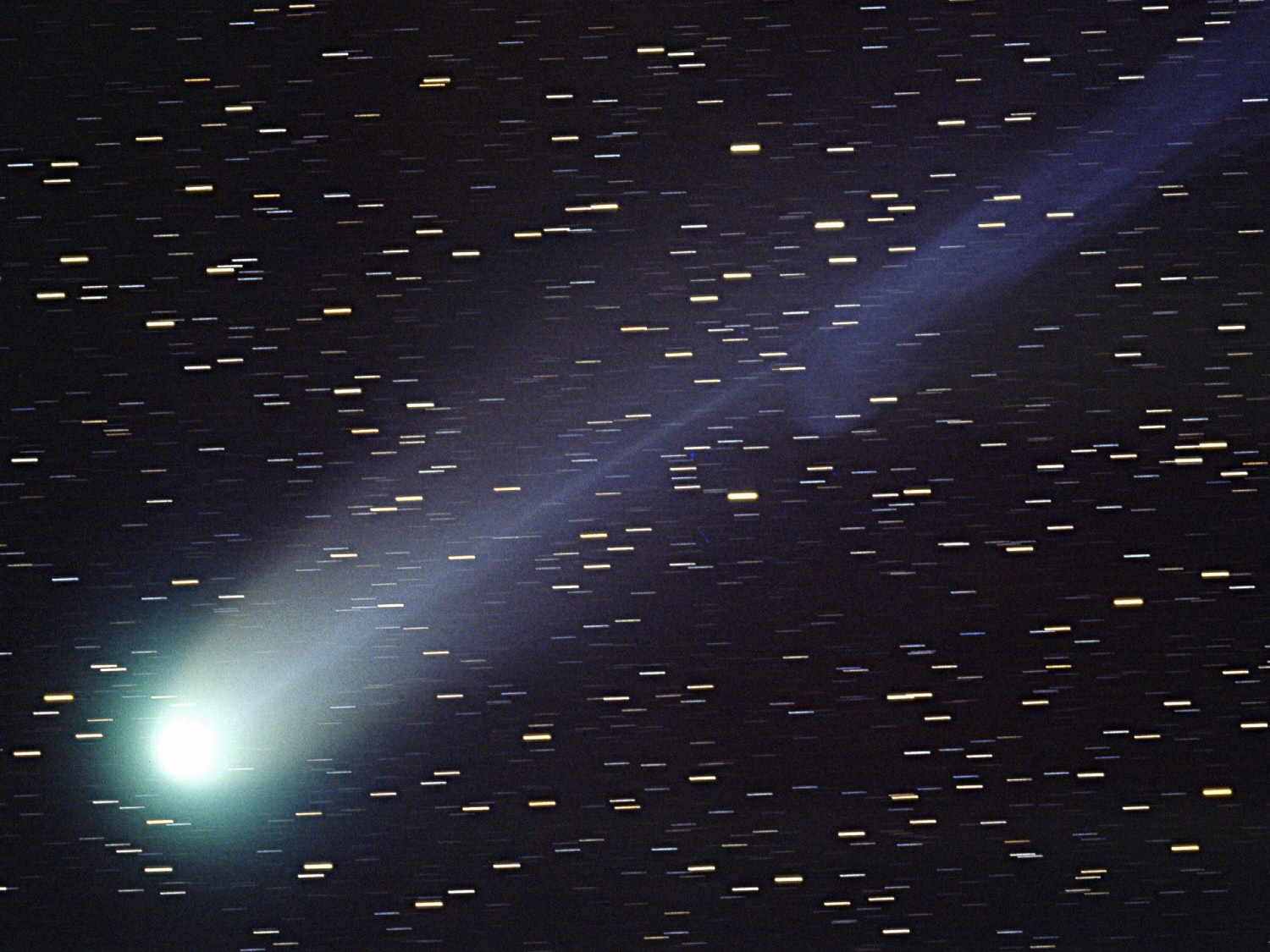
C/2011 J2 (LINEAR) is an Oort cloud comet discovered on 4 May 2011 by LINEAR at an apparent magnitude of 19.7 using a 1-meter (39 in) Reflecting telescope.[1][2] As of September 2014 the comet is around apparent magnitude 17.[3]
| Discovery | |
|---|---|
| Discovered by | LINEAR (704)[1][2] |
| Discovery date | 4 May 2011 |
| Orbital characteristics A | |
| Epoch | 14 December 2013[3] |
| Orbit type | Oort cloud |
| Aphelion | ~50000 AU (inbound)[4] |
| Perihelion | 3.4434 AU (q)[3] |
| Eccentricity | 1.00051[3] |
| Orbital period | several million years inbound (Barycentric solution for epoch 1950)[4] Ejection trajectory outbound (Barycentric solution for epoch 2050)[4] |
| Inclination | 122.79°[3] |
| Jupiter MOID | 0.55 AU |
| Last perihelion | 25 December 2013[3] |
C/2011 J2 came to perihelion (closest approach to the Sun) on 25 December 2013 at a distance of 3.4 AU from the Sun.[3] On 27 August 2014 an 18th magnitude fragment CK11J02b was detected.[3] Preliminary estimates are that a fragmentation event occurred around 14 July 2014 plus/minus ten days.[5] In mid-July 2014 the comet was 3.9 AU from the Sun.
Fragment C was detected in October 2014 by Ernesto Guido, Nick Howes, and Martino Nicolini.[6]
C/2011 J2 is dynamically new. It came from the Oort cloud with a loosely bound chaotic orbit that was easily perturbed by galactic tides and passing stars. Before entering the planetary region (epoch 1950), C/2011 J2 had an orbital period of several million years.[4] After leaving the planetary region (epoch 2050), it will be on an ejection trajectory.[4]
References
- "MPEC 2011-J31 : COMET C/2011 J2 (LINEAR)". IAU Minor Planet Center. 7 July 2011. Retrieved 18 September 2014. (CK11J020)
- Giovanni Sostero & Ernesto Guido (12 July 2011). "New Comet: C/2011 J2 (LINEAR)". Remanzacco. Retrieved 18 September 2014.
- "MPEC 2014-R69 : Observations and Orbits of Comets". IAU Minor Planet Center. 7 September 2014. Retrieved 18 September 2014.
- Horizons output. "Barycentric Osculating Orbital Elements for Comet C/2011 J2 (LINEAR)". Retrieved 18 September 2014. (Solution using the Solar System Barycenter and barycentric coordinates. Select Ephemeris Type:Elements and Center:@0)
- "Re: {MPML} C/2011 J2 LINEAR Nucleus splitting". 17 September 2014. Retrieved 18 September 2014.
- Ernesto Guido, Nick Howes & Martino Nicolini (13 October 2011). "New fragmentation event in C/2011 J2 (LINEAR)". Remanzacco. Retrieved 21 November 2014.
External links
- C/2011 J2 ( LINEAR ) – Seiichi Yoshida's Comet Catalog
- C/2011 J2 Linear: nucleus splitting (Virtual Telescope 19 September 2014)
- Comet C/2011 J2 in the process of fragmenting as seen on 2 September 2014
- Comet C/2011 J2 Linear splitting: a new image (24 Sept. 2014) (Virtual Telescope 25 September 2014)
- Follow-up of splitting event in Comet C/2011 J2 (Remanzacco 1 October 2014)



2013 in space | ||||||
|---|---|---|---|---|---|---|
| ||||||
Space probe launches  |
|    | ||||
| Impact events | ||||||
| Selected NEOs | ||||||
| Exoplanets |
| |||||
| Discoveries |
| |||||
| Novae | ||||||
| Comets |
| |||||
| Space exploration |
| |||||
| ||||||


Другой контент может иметь иную лицензию. Перед использованием материалов сайта WikiSort.org внимательно изучите правила лицензирования конкретных элементов наполнения сайта.
WikiSort.org - проект по пересортировке и дополнению контента Википедии