astro.wikisort.org - Comet
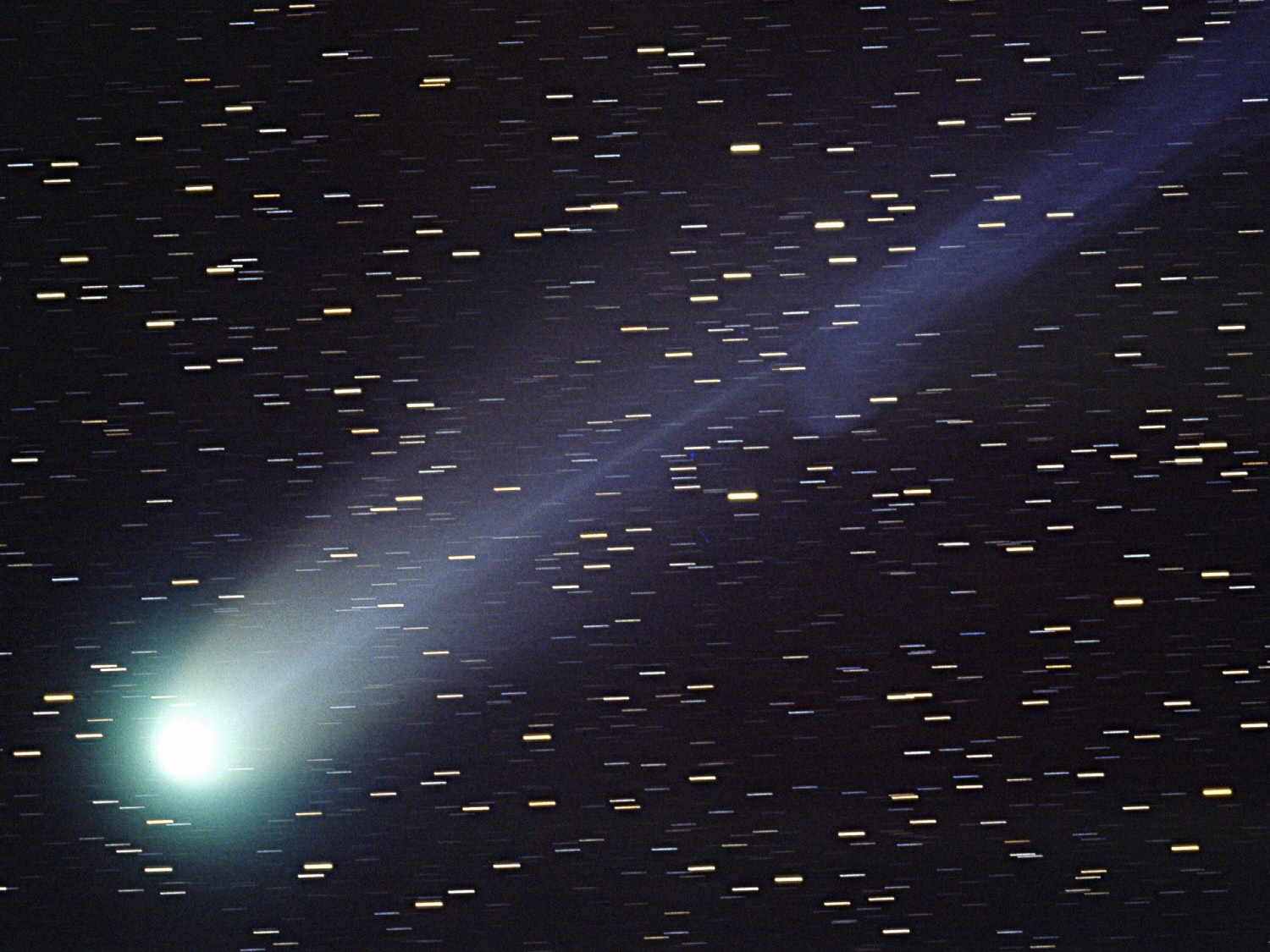
C/2016 R2 (PanSTARRS) is a comet, discovered using the Pan-STARRS telescopes on September 7, 2016. The comet attracted attention from many astronomers as it approached its closest point to the sun in May 2018.[3] It has been observed to have a very complex tail, which has been suggested to be due to a fast rotation period of the nucleus.
 The comet on 16 January 2018 | |
| Discovery [1] | |
|---|---|
| Discovered by | Pan-STARRS |
| Discovery site | Haleakala Obs. |
| Discovery date | 30 August 2016 |
| Designations | |
MPC designation | C/2016 R2 |
Minor planet category | comet |
| Orbital characteristics [2] | |
| Epoch 13 October 2018 | |
| Observation arc | 774 days |
| Perihelion | 2.60235 AU |
| Eccentricity | 0.99646 |
Mean anomaly | 359.9932° |
| Inclination | 58.222° |
Longitude of ascending node | 80.5685° |
Argument of perihelion | 33.1930° |
| Earth MOID | 1.72 AU |
| Physical characteristics | |
Absolute magnitude (H) | 8[2] |
The comet orbits the Sun on a 20,000 year orbit, which takes it out about 740 AU (Sun-Earth distances).[4] It was found to differ from typical comets, and was found to be rich in Carbon monoxide (CO) with a blue coma.[4] The blue color is thought to come from the rich amounts of carbon monoxide being ionized.[5] The comet was also noted to be rich in nitrogen.[6]
The comet was observed by a submillimeter wavelength telescope in the late 2010s.[4]
The comet made its closest approach to the Sun in May 2018, and its blue, teal, and dust tail were noted as an astronomical target.[5] Blue comets are a less common type of comet.[6]
Gallery
![Comet C/2016 R2 (PanSTARRS) taken by SPECULOOS project.[7]](//upload.wikimedia.org/wikipedia/commons/thumb/8/83/C2016_R2_%28PANSTARRS%29.tif/lossy-page1-120px-C2016_R2_%28PANSTARRS%29.tif.jpg) Comet C/2016 R2 (PanSTARRS) taken by SPECULOOS project.[7]
Comet C/2016 R2 (PanSTARRS) taken by SPECULOOS project.[7]
![Comet C/2016 R2 (PanSTARRS) taken by SPECULOOS project.[7]](http://upload.wikimedia.org/wikipedia/commons/thumb/8/83/C2016_R2_%28PANSTARRS%29.tif/lossy-page1-120px-C2016_R2_%28PANSTARRS%29.tif.jpg)
See also
References
- "MPEC 2016-R107: COMET C/2016 R2 (PANSTARRS)". IAU Minor Planet Center. 2016-09-09. Retrieved 26 November 2018.
- "JPL Small-Body Database Browser: C/2016 R2 (PANSTARRS)" (2018-04-13 last obs.). Jet Propulsion Laboratory. Retrieved 26 November 2018.
- "APOD: 2018 January 12 - Blue Comet PanSTARRS". apod.nasa.gov. 2018-01-12.
- "Comet C/2016 R2 (Pan-STARRS) is rich in carbon monoxide and depleted in hydrogen cyanide, study finds". Retrieved 2018-11-17.
- "Rare Carbon-Monoxide Comet Turns Blue in Stunning Deep-Space Photos". Space.com. Retrieved 2018-11-17.
- "Astronomers Spot Rare Blue Comet: C/2016 R2 | Astronomy | Sci-News.com". Breaking Science News | Sci-News.com. Retrieved 2018-11-17.
- "Once in a blue comet". www.eso.org. Retrieved 8 October 2019.
External links
- Comet C/2016 R2 (PanSTARRS) Information | TheSkyLive.com Archived 2018-01-21 at the Wayback Machine


2016 in space | ||
|---|---|---|
| ||
Space probe launches  |
|    |
| Impact events | ||
| Selected NEOs |
| |
| Exoplanets |
| |
| Discoveries |
| |
| Novae |
| |
| Comets |
| |
| Space exploration |
| |
| ||

 | This comet-related article is a stub. You can help Wikipedia by expanding it. |
Другой контент может иметь иную лицензию. Перед использованием материалов сайта WikiSort.org внимательно изучите правила лицензирования конкретных элементов наполнения сайта.
WikiSort.org - проект по пересортировке и дополнению контента Википедии