astro.wikisort.org - Galaxy
NGC 1898 is a globular cluster[3] in the constellation of Dorado at an approximate distance of 170,000 light-years.[1] NGC 1898 is located in the Large Magellanic Cloud, a satellite galaxy of the Milky Way,[1] and was for some time believed to be discovered by John Herschel in 1834; however recent research shows it was first observed by James Dunlop in 1826.[4][5]
| NGC 1898 | |
|---|---|
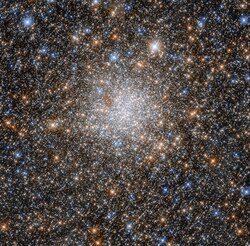 NGC 1898 taken by Hubble Space Telescope.[1] | |
| Observation data (J2000[2] epoch) | |
| Constellation | Dorado |
| Right ascension | 05h 16m 41.24s[2] |
| Declination | −69° 39′ 24.4″[2] |
| Distance | 170,000 ly |
| Apparent magnitude (V) | 11.86[2] |
| Physical characteristics | |
| Other designations | BSDL 2439, ESO 56-90, OGLE-CL LMC 292, [SL63] 350[2] |
References
- "Celestial fairy lights". www.spacetelescope.org. Retrieved 1 October 2018.
- "NGC 1898". SIMBAD. Centre de données astronomiques de Strasbourg. Retrieved 2018-10-01.
- Hodge, Paul W. (1960). "Studies of the Large Magellanic Cloud. I. The Red Globular Clusters". The Astrophysical Journal. 131: 351. Bibcode:1960ApJ...131..351H. doi:10.1086/146838.
- Seligman, C. "NGC 1898 (= an OCL in the LMC)". C Seligman.com. Retrieved 15 December 2019.
- Cozens, Glendyn John (2008). "An analysis of the first three catalogues of southern star clusters and nebulae" (PhD Thesis). James Cook University Australia. Retrieved 15 December 2019.
External links
 Media related to NGC 1898 at Wikimedia Commons

Constellation of Dorado | |||||||||||
|---|---|---|---|---|---|---|---|---|---|---|---|
| |||||||||||
| Stars |
| ||||||||||
| |||||||||||
| Star clusters |
| ||||||||||
| Nebulae |
| ||||||||||
| Galaxies |
| ||||||||||
| |||||||||||
| |||||||||||
 Category Category | |||||||||||
 | This star cluster–related article is a stub. You can help Wikipedia by expanding it. |
На других языках
[de] NGC 1898
NGC 1898 bezeichnet einen Kugelsternhaufen im Sternbild Schwertfisch. Er hat eine Entfernung von circa 160.000 Lichtjahren und ist Teil der Großen Magellanschen Wolke. Sein Alter beträgt mehr als 13,5 Milliarden Jahre und ähnelt dem der Kugelsternhaufen der Milchstraße.[3]- [en] NGC 1898
[ru] NGC 1898
NGC 1898 (другое обозначение — ESO 56-SC90) — шаровое скопление в созвездии Золотой Рыбы, расположенное в Большом Магеллановом Облаке. Открыто Джеймсом Данлопом в 1826 году. Описание Дрейера: «тусклый, довольно маленький объект круглой формы». В прошлом считалось, что Данлоп не наблюдал NGC 1898 и что первооткрывателем был Джон Гершель[2].Текст в блоке "Читать" взят с сайта "Википедия" и доступен по лицензии Creative Commons Attribution-ShareAlike; в отдельных случаях могут действовать дополнительные условия.
Другой контент может иметь иную лицензию. Перед использованием материалов сайта WikiSort.org внимательно изучите правила лицензирования конкретных элементов наполнения сайта.
Другой контент может иметь иную лицензию. Перед использованием материалов сайта WikiSort.org внимательно изучите правила лицензирования конкретных элементов наполнения сайта.
2019-2026
WikiSort.org - проект по пересортировке и дополнению контента Википедии
WikiSort.org - проект по пересортировке и дополнению контента Википедии