astro.wikisort.org - Galaxy
Messier 43 or M43, also known as De Mairan's Nebula and NGC 1982, is a star-forming nebula with a prominent H II region in the equatorial constellation of Orion. It was discovered by the French scientist Jean-Jacques Dortous de Mairan some time before 1731,[3] then catalogued by Charles Messier in 1769.[lower-alpha 1] It is physically part of the Orion Nebula (Messier 42), separate from that main nebula by a dense lane of dust known as the northeast dark lane.[5] It is part of the much larger Orion molecular cloud complex.
| Emission nebula | |
|---|---|
| H II region | |
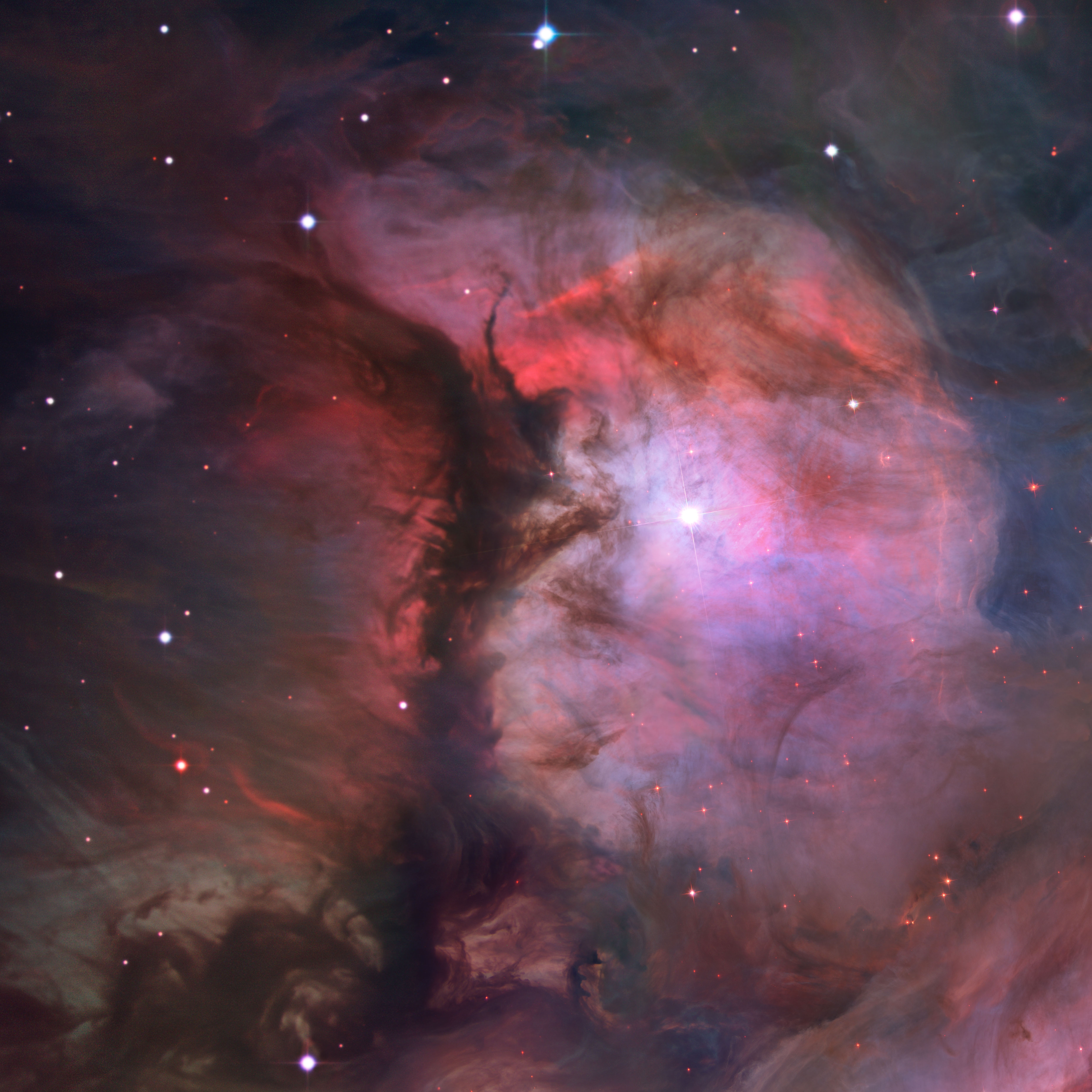 Emission nebula Messier 43 in Orion | |
| Observation data: J2000 epoch | |
| Right ascension | 05h 35m 31.8s[1] |
| Declination | −05° 17′ 57″[1] |
| Distance | 1,300 ± 160 ly (400 ± 50 pc) ly |
| Apparent magnitude (V) | 9.0[2] |
| Apparent dimensions (V) | 20′ × 15′[3] |
| Constellation | Orion |
| Notable features | Trapezium cluster |
| Designations | De Mairan's Nebula, M43, NGC 1982[4] |
The main ionizing star in this nebula is HD 37061 (variable star designation NU Ori[lower-alpha 2]), the focus of the H II region, 1,300 ± 160 ly (400 ± 50 pc) away.[lower-alpha 3] This is a triple star system with the brighter component being a single-lined spectroscopic binary. The main component is a blue-white hued B-type main-sequence star with a stellar classification of B0.5V or B1V. It has 19±7 times the mass of the Sun (M☉) and 5.7±0.8 times the Sun's radius (R☉). It is radiating over 26,000 times the Sun's luminosity (L☉) from its photosphere at an effective temperature of 31,000 K. It is spinning rapidly with a projected rotational velocity of around 200 km/s.[5]
The H II region is a roundish volume of ionized hydrogen. It has a diameter of about 4.5′, at its distance meaning it measures 2.1 ly (0.65 pc). The net (meaning omitting the star) hydrogen alpha luminosity of this region is (3.0±1.1)×1035 erg s−1; equivalent to 78 L☉. There is a dark lane crossing the whole west-centre strip from north to south, known as the M43 dark lane, which forming a swirling belt extension to the south links to Orion's northeast dark lane. All of these resemble a mixture of smoke rising from a chimney and in watercolour broad and fine dark brushstrokes, at many wavelengths.
Gallery
 Infrared view of (part of) De Mairan's Nebula (M43)

See also
- List of Messier objects
References and footnotes
- Sulentic, Jack W.; et al. (1973), The revised new catalogue of nonstellar astronomical objects, Tucson: University of Arizona Press, Bibcode:1973rncn.book.....S.
- "Messier 43". SEDS Messier Catalog. Retrieved 29 April 2022.
- Adam, Len (2018), Imaging the Messier Objects Remotely from Your Laptop, The Patrick Moore Practical Astronomy Series, Springer, p. 209, Bibcode:2018imor.book.....A, ISBN 978-3319653853.
- "M 43". SIMBAD. Centre de données astronomiques de Strasbourg. Retrieved November 25, 2018.
- Simón-Díaz, S.; et al. (June 2011), "A detailed study of the H ii region M 43 and its ionizing star", Astronomy & Astrophysics, 530: 13, arXiv:1103.3628, Bibcode:2011A&A...530A..57S, doi:10.1051/0004-6361/201116608, A57.
External links

- Garner, Rob, ed. (October 19, 2017), Messier 43, NASA, retrieved 2018-11-26.
- Frommert, Hartmut; Kronberg, Christine (October 8, 2018), Messier 43: De Mairan's Nebula, Companion of the Orion Nebula, Students for the Exploration and Development of Space (SEDS), retrieved 2018-11-26
- Messier 43 on WikiSky: DSS2, SDSS, GALEX, IRAS, Hydrogen α, X-Ray, Astrophoto, Sky Map, Articles and images
- On March 4
- Full name: NU Orionis
- Gaia Data Release 2 gives a parallax that would place it 1,706 ± 36 light-years (523 ± 11 pc) away


| List |
|  |
|---|---|---|
| See also |
| |
| ||


На других языках
[de] Messier 43
Messier 43 (auch als NGC 1982 oder De Mairans Nebel bezeichnet) ist ein Gasnebel im Sternbild Orion mit einer Helligkeit von +9,00 mag, der an den Orionnebel angrenzt. Der Nebel hat eine Winkelausdehnung von 20.0' × 15.0' nördlich von Messier 42 (Orionnebel).- [en] Messier 43
[ru] Туманность де Мерана
M 43 (Messier 43, Мессье 43, другое обозначение — NGC 1982) — эмиссионная туманность в созвездии Орион. Является областью ионизированного водорода, где происходят процессы активного звездообразования.Другой контент может иметь иную лицензию. Перед использованием материалов сайта WikiSort.org внимательно изучите правила лицензирования конкретных элементов наполнения сайта.
WikiSort.org - проект по пересортировке и дополнению контента Википедии