astro.wikisort.org - Star
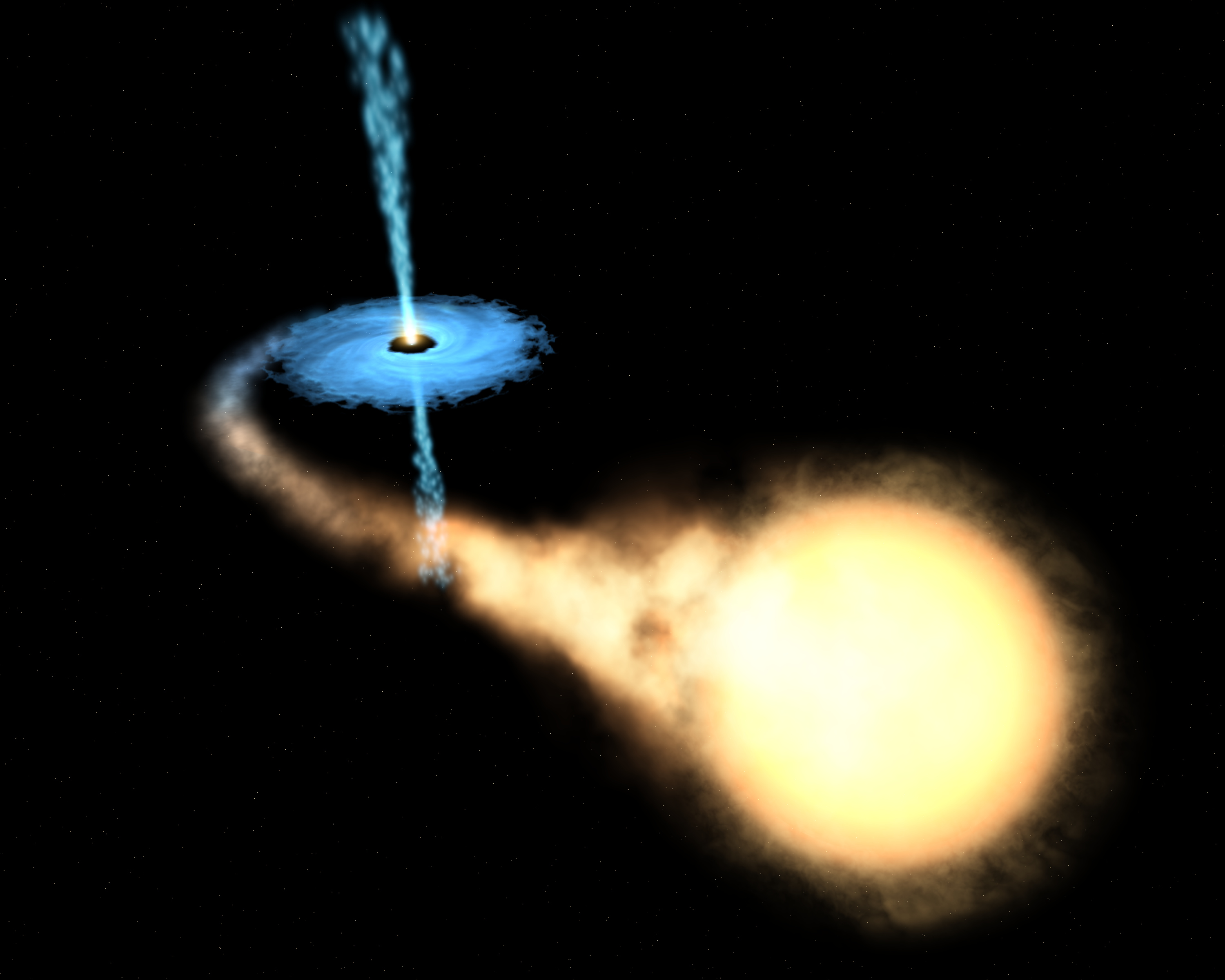
PSR J1302−6350 is a pulsar and member of an eclipsing binary star system with the blue O9.5Ve-class star LS 2883. The pair has an eccentric orbit that is inclined to the line of sight from Earth by about 36°, leading to a 40-day-long eclipse each time the pulsar passes behind the star.[4] The pulsar has a period of about 48 ms and a luminosity of 8.3 × 1035 erg/s. It emits very high energy gamma rays that vary on a time scale of several days.[6]
| Observation data Epoch J2000 Equinox J2000 | |
|---|---|
| Constellation | Centaurus |
| Right ascension | 13h 02m 47.655s[1] |
| Declination | −63° 50′ 08.67″[1] |
| Apparent magnitude (V) | 10.34 |
| Characteristics | |
| Spectral type | O9.5Ve[2] + pulsar |
| Astrometry | |
| Proper motion (μ) | RA: −6.0[1] mas/yr Dec.: −5.7[1] mas/yr |
| Distance | 7,500[3] ly |
| Orbit[4] | |
| Companion | SS 2883 |
| Period (P) | 1237 days |
| Eccentricity (e) | 0.87 |
| Inclination (i) | 36° |
| Other designations | |
| Database references | |
| SIMBAD | data |

The star LS 2883 has about 10 solar masses and is 6 solar radii in size. The rate of rotation is about 280 km/s at the equator, or 70% of the breakup velocity.[4]
References
- Høg, E.; Fabricius, C.; Makarov, V. V.; Urban, S.; Corbin, T.; Wycoff, G.; Bastian, U.; Schwekendiek, P.; Wicenec, A. (2000). "The Tycho-2 catalogue of the 2.5 million brightest stars". Astronomy and Astrophysics. 355: L27. Bibcode:2000A&A...355L..27H. doi:10.1888/0333750888/2862.
- Chernyakova, M.; et al. (March 2014). "Multiwavelength observations of the binary system PSR B1259-63/LS 2883 around the 2010-2011 periastron passage". Monthly Notices of the Royal Astronomical Society. 439 (1): 432–445. arXiv:1401.1386. Bibcode:2014MNRAS.439..432C. doi:10.1093/mnras/stu021. S2CID 55330740.
- Universidad de Barcelona (May 2, 2011). "Discovery of Structure of Radio Source from a Pulsar Orbiting a Massive Star". ScienceDaily.
- Wang, N.; Johnston, S.; Manchester, R. N. (June 2004). "13 years of timing of PSR B1259-63". Monthly Notices of the Royal Astronomical Society. 351 (2): 599–606. arXiv:astro-ph/0403612. Bibcode:2004MNRAS.351..599W. doi:10.1111/j.1365-2966.2004.07806.x. S2CID 119397388.
- "TYC 8997-1597-1 -- Pulsar". SIMBAD. Centre de données astronomiques de Strasbourg. Retrieved 2009-01-06.
- Aharonian, F.; et al. (2005). "Discovery of the Binary Pulsar PSR B1259-63 in Very-High-Energy Gamma Rays around Periastron with H.E.S.S.". Astronomy & Astrophysics. 442 (1): 1–10. arXiv:astro-ph/0506280. Bibcode:2005A&A...442....1A. doi:10.1051/0004-6361:20052983. S2CID 11673268.
External links
Constellation of Centaurus | |||||
|---|---|---|---|---|---|
| |||||
| Stars | |||||
| |||||
| |||||
| |||||
| Galaxies |
| ||||
| |||||
| |||||
 Category Category | |||||
 | This binary or multiple star system–related article is a stub. You can help Wikipedia by expanding it. |
 | This variable star–related article is a stub. You can help Wikipedia by expanding it. |
На других языках
- [en] PSR B1259−63/LS 2883
[es] TYC 8997-1597-1
TYC 8997-1597-1 (CPD-63 2495)[1] es una sistema binario compuesto por un púlsar, PSR B1259-63, y una estrella, SS 2883 (LS 2883). Situado en la constelación de la Cruz del Sur, tiene magnitud aparente +10,08 y se encuentra a unos 5000 años luz de distancia del Sistema Solar.Другой контент может иметь иную лицензию. Перед использованием материалов сайта WikiSort.org внимательно изучите правила лицензирования конкретных элементов наполнения сайта.
WikiSort.org - проект по пересортировке и дополнению контента Википедии