astro.wikisort.org - Star
RR Centauri is a variable star of apparent magnitude maximum +7.29. It is located in the constellation of Centaurus, approximately 320 light years distant from the solar system.[6]
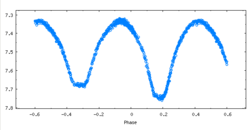 Light curve of RR Cen. | |
| Observation data Epoch J2000 Equinox J2000 | |
|---|---|
| Constellation | Centaurus |
| Right ascension | 14h 16m 57.22s[1] |
| Declination | −57° 51′ 15.6″[1] |
| Apparent magnitude (V) | 7.29[2] (7.27 - 7.68[3]) |
| Characteristics | |
| Spectral type | F0 V[4] |
| U−B color index | +0.05[2] |
| B−V color index | +0.36[2] |
| Variable type | W Uma[3] |
| Astrometry | |
| Radial velocity (Rv) | -16.0 [5] km/s |
| Proper motion (μ) | RA: -52.00[6] mas/yr Dec.: -22.63[6] mas/yr |
| Parallax (π) | 10.16 ± 0.61 mas[6] |
| Distance | 320 ± 20 ly (98 ± 6 pc) |
| Absolute magnitude (MV) | +1.882[4] |
| Orbit[7] | |
| Primary | RR Cen1 |
| Companion | RR Cen2 |
| Period (P) | 0.60569 days |
| Semi-major axis (a) | 3.92 ± 0.19 R☉ |
| Eccentricity (e) | 0 |
| Inclination (i) | 81.00 ± 0.44° |
| Details[7] | |
| RR Cen1 | |
| Mass | 1.82 ± 0.26 M☉ |
| Radius | 2.1 ± 0.01 R☉ |
| Luminosity | 8.89 L☉ |
| Temperature | 6,912 K |
| RR Cen2 | |
| Mass | 0.38 ± 0.06 M☉ |
| Radius | 1.05 ± 0.03 R☉ |
| Luminosity | 2.2 L☉ |
| Temperature | 6,891 ± 13 K |
| Other designations | |
| Database references | |
| SIMBAD | data |
The system is a contact binary of the W UMa type - two stars in physical contact whose two components share a gaseous envelope. Its spectral type is A9V or F0V.[1] The binary nature of the star was discovered in 1896 by the Scottish-South African astronomer Alexander Roberts, so the system has been well observed for over a century.[8] The primary component has a mass of 1.82 solar masses, an effective temperature of around 6900 K, and a radius somewhat larger than twice the solar radius.[7] The secondary component is 0.39 solar masses, giving a mass ratio of the system (q) of 0.210. the secondary has a temperature of about 6890 K and a radius is almost equal to the solar radius.
The orbital period of this system is 0.6057 days (14.53 hours). Recent calculations by astronomers from the Chinese Academy of Sciences show a possible cyclic variation in orbital period over 65.1 ± 0.4 years whose amplitude is 0.0124 ± 0.0007 days.[7] The origin of this periodic variation could be due to the gravitational influence of a third object yet observed. Superimposed on this variation seems to be a secular increase in the period of 1.21 x 10 –7 days per year, suggesting that there is transfer of stellar mass from secondary to primary component. If this increase is confirmed, RR Centauri may evolve into a single rapidly rotating star.
RR Centauri is also an eclipsing binary, whose apparent brightness varies by around 0.41 magnitudes.[7]
References
- "V* RR Cen -- Eclipsing binary of W UMa type (contact binary)". SIMBAD. Centre de Données astronomiques de Strasbourg. Retrieved 2016-02-27.
- Loden, L.O. (1979). "Continued studies of loose clusterings in the Southern Milky Way". Astronomy and Astrophysics Supplement. 38: 355. Bibcode:1979A&AS...38..355L.
- Samus, N. N.; Durlevich, O. V.; et al. (2009). "VizieR Online Data Catalog: General Catalogue of Variable Stars (Samus+ 2007-2013)". VizieR On-line Data Catalog: B/GCVS. Originally Published in: 2009yCat....102025S. 1. Bibcode:2009yCat....102025S.
- Eker, Z.; Bilir, S.; Yaz, E.; Demircan, O.; Helvaci, M. (2009). "New absolute magnitude calibrations for W Ursa Majoris type binaries". Astronomische Nachrichten. 330 (1): 68–76. arXiv:0807.4989. Bibcode:2009AN....330...68E. doi:10.1002/asna.200811041. S2CID 15071352.
- Bilir, S; Karatas, Y; Demircan, O; Eker, Z (2005). "Kinematics of W Ursae Majoris type binaries and evidence of the two types of formation". Monthly Notices of the Royal Astronomical Society. 357 (2): 497–517. arXiv:astro-ph/0411291. Bibcode:2005MNRAS.357..497B. doi:10.1111/j.1365-2966.2005.08609.x. S2CID 16274339.
- van Leeuwen, F. (November 2007). "Validation of the new Hipparcos reduction". Astronomy and Astrophysics. 474 (2): 653–664. arXiv:0708.1752. Bibcode:2007A&A...474..653V. doi:10.1051/0004-6361:20078357. S2CID 18759600.
- Yuan-Gui, Y.; Sheng-Bang, Q.; Li-Ying, Z.; Jia-Jia, H.; Jin-Zhao, Y (2005). "Photometric Investigations of Three Short-Period Binary Systems: GSC 0763–0572, RR Centauri, and Epsilon Coronae Australis". Publications of the Astronomical Society of Japan. 57 (6): 983–993. Bibcode:2005PASJ...57..983Y. doi:10.1093/pasj/57.6.983.
- Roberts, Alexander (1903). "Determination of the Orbital Elements of RR Centauri from the Observed Light Curve". Monthly Notices of the Royal Astronomical Society. 63 (8): 540–549. Bibcode:1903MNRAS..63..536R. doi:10.1093/mnras/63.8.527.
Constellation of Centaurus | |||||
|---|---|---|---|---|---|
| |||||
| Stars | |||||
| |||||
| |||||
| |||||
| Galaxies |
| ||||
| |||||
| |||||
 Category Category | |||||
Другой контент может иметь иную лицензию. Перед использованием материалов сайта WikiSort.org внимательно изучите правила лицензирования конкретных элементов наполнения сайта.
WikiSort.org - проект по пересортировке и дополнению контента Википедии