astro.wikisort.org - Galaxy
NGC 2090 is a spiral galaxy located approximately 40 million light-years from the Solar System[1] in the Columba constellation. It was discovered on 29 October 1826 by Scottish astronomer James Dunlop.[4] NGC 2090 was studied to refine the Hubble constant to an accuracy within ±10%.[1]
| NGC 2090 | |
|---|---|
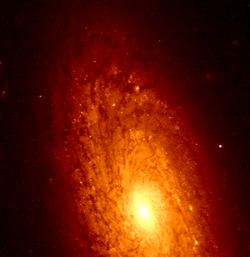 NGC 2090 captured by the Hubble Space Telescope in 2015. | |
| Observation data (J2000 epoch) | |
| Constellation | Columba |
| Right ascension | 05h 48m 22.3s[1] |
| Declination | −34° 13′ 37″[1] |
| Redshift | 0.003079[2] |
| Helio radial velocity | 921.5 km/s[2] |
| Distance | 40.1 ± 2.9 Mly (12.3 ± 0.9 Mpc)[1] |
| Apparent magnitude (V) | 11.20[3] |
| Apparent magnitude (B) | 11.99[3] |
| Characteristics | |
| Type | SA:(rs)c[3] |
| Apparent size (V) | 4.9′ × 2.4′[3] |
| Other designations | |
| MCG -06-13-009, PGC 17819[2] | |
See also
Gallery


References
- Phelps, Randy L.; Sakai, Shoko; Freedman, Wendy L.; Madore, Barry F.; Saha, Abhijit; Stetson, Peter B.; Kennicutt, Robert C.; Mould, Jeremy R.; Ferrarese, Laura; Ford, Holland C.; Gibson, Brad K.; Graham, John A.; Han, Mingsheng; Hoessel, John G.; Huchra, John P.; Hughes, Shaun M.; Illingworth, Garth D.; Silbermann, N. A. (1998). "The Hubble Space Telescope Extragalactic Distance Scale Key Project. IX. The Discovery of Cepheids in NGC 2090". The Astrophysical Journal. 500 (2): 763–788. Bibcode:1998ApJ...500..763P. doi:10.1086/305766.
- "NGC 2090". SIMBAD. Centre de données astronomiques de Strasbourg. Retrieved 2021-02-25.
- Gil de Paz, Armando; et al. (December 2007). "The GALEX Ultraviolet Atlas of Nearby Galaxies". The Astrophysical Journal Supplement Series. 173 (2): 185–255. arXiv:astro-ph/0606440. Bibcode:2007ApJS..173..185G. doi:10.1086/516636. S2CID 119085482.
- "New General Catalog Objects: NGC 2050 - 2099". cseligman.com. Retrieved 2017-12-14.
External links

Wikimedia Commons has media related to NGC 2090.
- NGC 2090 on WikiSky: DSS2, SDSS, GALEX, IRAS, Hydrogen α, X-Ray, Astrophoto, Sky Map, Articles and images
- SEDS
Constellation of Columba | |||||||||||
|---|---|---|---|---|---|---|---|---|---|---|---|
| |||||||||||
| Stars |
| ||||||||||
| |||||||||||
| |||||||||||
| Galaxies |
| ||||||||||
 Category Category | |||||||||||
 | This spiral galaxy article is a stub. You can help Wikipedia by expanding it. |
На других языках
[de] NGC 2090
NGC 2090 ist eine Spiralgalaxie im Sternbild Taube. Die Galaxie wurde am 29. Oktober 1826 von dem Astronomen James Dunlop mit einem 9"-Teleskop entdeckt; die Entdeckung wurde später im New General Catalogue verzeichnet.[3]- [en] NGC 2090
[ru] NGC 2090
NGC 2090 (другие обозначения — ESO 363-23, MCG −6-13-9, AM 0545-341, IRAS05452-3416, PGC 17819) — спиральная галактика (Sc) в созвездии Голубь.Текст в блоке "Читать" взят с сайта "Википедия" и доступен по лицензии Creative Commons Attribution-ShareAlike; в отдельных случаях могут действовать дополнительные условия.
Другой контент может иметь иную лицензию. Перед использованием материалов сайта WikiSort.org внимательно изучите правила лицензирования конкретных элементов наполнения сайта.
Другой контент может иметь иную лицензию. Перед использованием материалов сайта WikiSort.org внимательно изучите правила лицензирования конкретных элементов наполнения сайта.
2019-2026
WikiSort.org - проект по пересортировке и дополнению контента Википедии
WikiSort.org - проект по пересортировке и дополнению контента Википедии