astro.wikisort.org - Galaxy
NGC 5177 is a lenticular galaxy. Based on a redshift of 6467 km/s the galaxy is crudely estimated to be about 300 million light-years away.[1]
| NGC 5177 | |
|---|---|
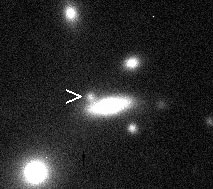 NGC 5177 with SN 2010cr May 19, 2010 | |
| Observation data (J2000 epoch) | |
| Constellation | Virgo |
| Right ascension | 13h 29m 24.2s[1] |
| Declination | +11° 47′ 49″[1] |
| Redshift | 0.021570[1] |
| Helio radial velocity | 6467 ± 29 km/s[1] |
| Distance | 297 Mly (Light Travel-Time)[1] (redshift-based) |
| Apparent magnitude (V) | 15.1g[1] |
| Characteristics | |
| Type | S0[1] |
| Apparent size (V) | 0.81' x 0.46'[1] |
| Other designations | |
| MCG +02-34-019, PGC 47337[2] | |
On April 16, 2010 UT, the Palomar Transient Factory automated wide-field survey detected a supernova on the outskirts of NGC 5177.[3] The supernova is known as SN 2010cr[4] and is located at 13:29:25.11 +11:47:46.4.[3] A confirmation spectrum was taken with the Palomar Hale telescope on April 17 UT which showed it to be approximately 13 days before peak brightness.[3] The Hubble Space Telescope took STIS/UV spectroscopic observations on May 3, 2010.[5]

See also

- List of supernovae
- History of supernova observation
- List of supernova remnants
- List of supernova candidates
References
- "NASA/IPAC Extragalactic Database". Results for NGC 5177. Retrieved 2010-05-19.
- "NGC 5177". SIMBAD. Centre de données astronomiques de Strasbourg. Retrieved 2021-02-19.
- "Nearby supernova, PTF10fps". The Astronomer's Telegram. 2010-04-22. Retrieved 2010-05-19.
- "List of Supernovae". Central Bureau for Astronomical Telegrams. Retrieved 2011-07-03.
- Richard S. Ellis (2010-05-03). "HST Preview for OBD708010". [Hubble Legacy Archive]. Retrieved 2010-05-19.
External links

Wikimedia Commons has media related to NGC 5177.
- NGC 5177 on WikiSky: DSS2, SDSS, GALEX, IRAS, Hydrogen α, X-Ray, Astrophoto, Sky Map, Articles and images
 | This lenticular galaxy article is a stub. You can help Wikipedia by expanding it. |
На других языках
[de] NGC 5177
NGC 5177 ist eine 14,6 mag helle Galaxie vom Hubble-Typ S im Sternbild Jungfrau auf der Ekliptik. Sie ist schätzungsweise 288 Millionen Lichtjahre von der Milchstraße entfernt und hat einen Durchmesser von etwa 60.000 Lichtjahren. Gemeinsam mit NGC 5176 bildet sie das Galaxienpaar Holm 521 und zusammen mit NGC 5171, NGC 5178 und NGC 5179 eine kleine Galaxiengruppe.- [en] NGC 5177
[ru] NGC 5177
NGC 5177 (другие обозначения — MCG 2-34-19, ZWG 72.91, PGC 47337) — галактика в созвездии Дева.Текст в блоке "Читать" взят с сайта "Википедия" и доступен по лицензии Creative Commons Attribution-ShareAlike; в отдельных случаях могут действовать дополнительные условия.
Другой контент может иметь иную лицензию. Перед использованием материалов сайта WikiSort.org внимательно изучите правила лицензирования конкретных элементов наполнения сайта.
Другой контент может иметь иную лицензию. Перед использованием материалов сайта WikiSort.org внимательно изучите правила лицензирования конкретных элементов наполнения сайта.
2019-2026
WikiSort.org - проект по пересортировке и дополнению контента Википедии
WikiSort.org - проект по пересортировке и дополнению контента Википедии