astro.wikisort.org - Galaxy
NGC 4318 is a small lenticular galaxy[3] located about 72 million light-years away[5] in the constellation Virgo. It was discovered by astronomer John Herschel on January 18, 1828.[6] NGC 4318 is a member of the Virgo W′ group,[2][7][8][9] a group of galaxies in the background of the Virgo Cluster[2] that is centered on the giant elliptical galaxy NGC 4365.[9]
| NGC 4318 | |
|---|---|
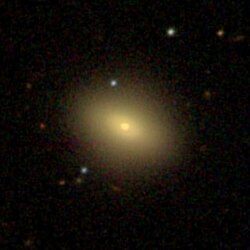 SDSS image of NGC 4318. | |
| Observation data (J2000 epoch) | |
| Constellation | Virgo |
| Right ascension | 12h 22m 43.3s[1] |
| Declination | 08° 11′ 54″[1] |
| Redshift | 0.004106[1] |
| Helio radial velocity | 1231 km/s[1] |
| Distance | 72 Mly (22 Mpc)[1] |
| Group or cluster | Virgo W′ group[2] |
| Apparent magnitude (V) | 13.8[1] |
| Characteristics | |
| Type | S0[3] |
| Mass | 7.2×1009[4] M☉ |
| Size | ~22,000 ly (6.7 kpc) (estimated)[1] |
| Apparent size (V) | 0.84 x 0.69[1] |
| Other designations | |
| UGC 07446, VCC 0575, PGC 040122, MCG +02-32-015[1] | |
Physical characteristics
NGC 4318 contains a small,[3] classical bulge[10] and a nuclear stellar disc with a diameter of ~230 ly (70 pc).[11] Outside the nuclear stellar disc lies a sharply bounded, low surface brightness region with a diameter of ~1,800 ly (560 pc) beyond which lies a larger outer disk.[3][12]
Black Hole
NGC 4318 harbors a supermassive black hole with an estimated mass of 4 million (5×10⁶ M☉) solar masses.[13][14][15]
Globular clusters
NGC 4318 is surrounded by 18 globular clusters.[16][17]
See also
References
- "NASA/IPAC Extragalactic Database". Results for NGC 4318. Retrieved 2019-08-31.
- Merritt, David; Anthony, Andre; Peng, Eric; Jordan, Andres; Ferrarese, Laura; West, Michael; Tonry, John; Cote, Patrick; Blakeslee, John (2007-02-20). "The ACS Virgo Cluster Survey. XIII. SBF Distance Catalog and the Three-Dimensional Structure of the Virgo Cluster". The Astrophysical Journal. 655 (1): 144–162. arXiv:astro-ph/0702510. Bibcode:2007ApJ...655..144M. doi:10.1086/509598. S2CID 16483538.
- Bender, Ralf; Cornell, Mark E.; Fisher, David B.; Kormendy, John (2009). "Structure and Formation of Elliptical and Spheroidal Galaxies". The Astrophysical Journal Supplement Series. 182 (1): 216–309. arXiv:0810.1681. Bibcode:2009ApJS..182..216K. doi:10.1088/0067-0049/182/1/216. S2CID 119273143.
- Couch, Warrick J.; Forbes, Duncan A.; Hau, George K. T.; Spolaor, Max (2010-07-05). "Early-type galaxies at large galactocentric radii - I. Stellar kinematics and photometric properties". Monthly Notices of the Royal Astronomical Society. 408 (1): 254–271. arXiv:1007.0599v1. Bibcode:2010MNRAS.408..254S. doi:10.1111/j.1365-2966.2010.17282.x.
- "Your NED Search Results". ned.ipac.caltech.edu. Retrieved 2019-09-01.
- "New General Catalog Objects: NGC 4300 - 4349". cseligman.com. Retrieved 2019-08-19.
- West, Michael J.; Tonry, John L.; Peng, Eric W.; Infante, Leopoldo; Ferrarese, Laura; Cote, Patrick; Mei, Simona; Jordan, Andres; Blakeslee, John P. (2009-01-08). "The ACS Fornax Cluster Survey. V. Measurement and Recalibration of Surface Brightness Fluctuations and a Precise Value of the Fornax--Virgo Relative Distance". The Astrophysical Journal. 694 (1): 556–572. arXiv:0901.1138. Bibcode:2009ApJ...694..556B. doi:10.1088/0004-637X/694/1/556. S2CID 16521293.
- West, Michael J.; Tonry, John L.; Infante, Leopoldo; Mei, Simona; Kissler-Patig, Markus; Ferrarese, Laura; Cote, Patrick; Blakeslee, John P.; Peng, Eric W. (2010-04-16). "The ACS Fornax Cluster Survey. VIII. The Luminosity Function of Globular Clusters in Virgo and Fornax Early-Type Galaxies and its Use as a Distance Indicator". The Astrophysical Journal. 717 (2): 603–616. arXiv:1004.2883v1. Bibcode:2010ApJ...717..603V. doi:10.1088/0004-637X/717/2/603.
- Schindler, Sabine; Vikhlinin, Alexey; Nulsen, Paul E. J.; Li, Zhiyuan; Churazov, Eugene; Zhuravleva, Irina; Zhang, Zhongli; Randall, Scott W.; Blom, Christina (2012-03-07). "Chandra observations of NGC4342, an optically faint, X-ray gas-rich early-type galaxy". The Astrophysical Journal. 755 (1): 25. arXiv:1203.1642v2. Bibcode:2012ApJ...755...25B. doi:10.1088/0004-637X/755/1/25.
- Romanowsky, Aaron J.; Fall, S. Michael (2018-08-07). "Angular Momentum and Galaxy Formation Revisited: Scaling Relations for Disks and Bulges". The Astrophysical Journal. 868 (2): 133. arXiv:1808.02525v2. Bibcode:2018ApJ...868..133F. doi:10.3847/1538-4357/aaeb27. S2CID 119061427.
- Ledo, H. R.; Sarzi, M.; Dotti, M.; Khochfar, S.; Morelli, L. (2010-09-01). "A census of nuclear stellar discs in early-type galaxies". Monthly Notices of the Royal Astronomical Society. 407 (2): 969–985. Bibcode:2010MNRAS.407..969L. doi:10.1111/j.1365-2966.2010.16990.x. ISSN 0035-8711.
- West, Michael J.; Tonry, John L.; Milosavljevic, Milos; Merritt, David; Mei, Simona; Piatek, Slawomir; Blakeslee, John P.; Peng, Eric W.; Jordan, Andres (2006-02-14). "The ACS Virgo Cluster Survey. VI. Isophotal Analysis and the Structure of Early-Type Galaxies". The Astrophysical Journal Supplement Series. 164 (2): 334–434. arXiv:astro-ph/0602297. Bibcode:2006ApJS..164..334F. doi:10.1086/501350. S2CID 18618068.
- Gallo, Elena; Treu, Tommaso; Marshall, Philip J.; Woo, Jong-Hak; Leipski, Christian; Antonucci, Robert (2010-05-01). "AMUSE-Virgo. II. Down-sizing in Black Hole Accretion". The Astrophysical Journal. 714 (1): 25–36. arXiv:1002.3619. Bibcode:2010ApJ...714...25G. doi:10.1088/0004-637X/714/1/25. hdl:1721.1/95905. ISSN 0004-637X. S2CID 53603460.
- Antonucci, Robert; Miller, Brendan P.; Woo, Jong-Hak; Treu, Tommaso; Gallo, Elena; Leipski, Christian (2011-11-29). "AMUSE-VIRGO. III: mid-infrared photometry of early-type galaxies and limits on obscured nuclear emission". The Astrophysical Journal. 744 (2): 152. arXiv:1111.6774. doi:10.1088/0004-637X/744/2/152. S2CID 119203992.
- "VizieR". vizier.u-strasbg.fr. Retrieved 2019-09-01.
- Alessi, Matthew; Harris, Gretchen L. H.; Harris, William E. (2013-06-10). "A Catalog of Globular Cluster Systems: What Determines the Size of a Galaxy's Globular Cluster Population?". The Astrophysical Journal. 772 (2): 82. arXiv:1306.2247v1. Bibcode:2013ApJ...772...82H. doi:10.1088/0004-637X/772/2/82.
- West, Andrew A.; Tonry, John L.; Mei, Simona; Ferrarese, Laura; Chen, Chin-Wei; Blakeslee, John P.; West, Michael J.; Takamiya, Marianne; Cote, Patrick (2008-03-04). "The ACS Virgo Cluster Survey XV. The Formation Efficiencies of Globular Clusters in Early-Type Galaxies: The Effects of Mass and Environment". The Astrophysical Journal. 681 (1): 197. arXiv:0803.0330v1. Bibcode:2008ApJ...681..197P. doi:10.1086/587951.
External links

- NGC 4318 on WikiSky: DSS2, SDSS, GALEX, IRAS, Hydrogen α, X-Ray, Astrophoto, Sky Map, Articles and images
На других языках
[de] NGC 4318
NGC 4318 ist eine elliptische Zwerggalaxie vom Hubble-Typ E3[4] im Sternbild Jungfrau an der Ekliptik. Sie ist schätzungsweise 52 Millionen Lichtjahre von der Milchstraße entfernt und hat einen Durchmesser von etwa 10.000 Lichtjahren. Die Galaxie ist unter der Katalognummer VCC 575 als Mitglied des Virgo-Galaxienhaufens gelistet. Im selben Himmelsareal befinden sich u. a. die Galaxien NGC 4356, IC 3266, IC 3271, IC 3273.- [en] NGC 4318
[ru] NGC 4318
NGC 4318 (другие обозначения — UGC 7446, ARAK 359, MCG 2-32-15, VCC 575, ZWG 42.59, ZWG 70.33, PGC 40122) — эллиптическая галактика (E) в созвездии Дева.Другой контент может иметь иную лицензию. Перед использованием материалов сайта WikiSort.org внимательно изучите правила лицензирования конкретных элементов наполнения сайта.
WikiSort.org - проект по пересортировке и дополнению контента Википедии